


Page 250 - MODELING OF ASPHALT CONCRETE
P. 250
228    Cha pte r  Ei g h t


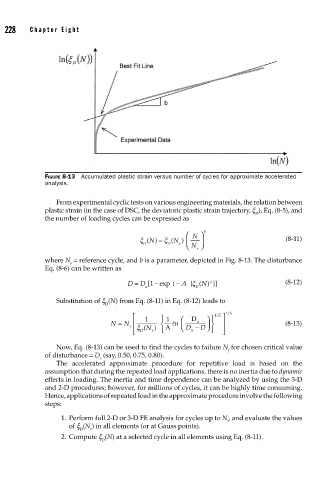
                    FIGURE 8-13  Accumulated plastic strain versus number of cycles for approximate accelerated
                    analysis.

                       From experimental cyclic tests on various engineering materials, the relation between
                    plastic strain (in the case of DSC, the deviatoric plastic strain trajectory, x ), Eq. (8-5), and
                                                                                D
                    the number of loading cycles can be expressed as
                                                            ⎛  N ⎞  b
                                               ξ N() =  ξ N )   ⎟                       (8-11)
                                                        (
                                                D      D  r ⎜ ⎝  N r ⎠
                    where N  = reference cycle, and b is a parameter, depicted in Fig. 8-13. The disturbance
                           r
                    Eq. (8-6) can be written as
                                                   −
                                            D =  D [1exp  (  −  A { (ξ  N }]) Z         (8-12)
                                                 u             D
                       Substitution of x (N) from Eq. (8-11) in Eq. (8-12) leads to
                                     D
                                             ⎡  1    ⎧ 1   ⎛  D   ⎞ ⎫ 1/ Z  ⎤ 1/b
                                       N =  N ⎢      ⎨   n    ⎜  D − u  ⎟ ⎬  ⎥          (8-13)
                                            r
                                             ⎢ ⎣  ξ ( N )  ⎩  A  ⎝  u  D ⎠  ⎭  ⎥ ⎦ ⎦
                                                  r
                                               D
                       Now, Eq. (8-13) can be used to find the cycles to failure N  for chosen critical value
                                                                        f
                    of disturbance = D  (say, 0.50, 0.75, 0.80).
                                    c
                       The accelerated approximate procedure for repetitive load is based on the
                    assumption that during the repeated load applications, there is no inertia due to dynamic
                    effects in loading. The inertia and time dependence can be analyzed by using the 3-D
                    and 2-D procedures; however, for millions of cycles, it can be highly time consuming.
                    Hence, applications of repeated load in the approximate procedure involve the following
                    steps:
                         1.  Perform full 2-D or 3-D FE analysis for cycles up to N , and evaluate the values
                                                                        r
                           of x (N ) in all elements (or at Gauss points).
                              D  r
                         2. Compute x (N) at a selected cycle in all elements using Eq. (8-11).
                                    D

