


Page 193 - Modeling of Chemical Kinetics and Reactor Design
P. 193
Reaction Rate Expression 163
1 − C A T π O
T π
X = C AO T π or C A = 1 − X X Tπ (3-220)
O
A
O
+ ε
A
1 +ε A C A T π O C AO 1 A A O
C T π
AO O
C BO − C B T π O C BO − b X
X = C AO C AO Tπ or C B = C AO a A T π (3-221)
O
A
b C Tπ O C AO 1 + ε A X A Tπ O
+ ε A B
a C AO T π
O
C C Tπ O − C CO C CO + c
C T π C C C a X A T π
X = AO O AO or C = AO O (3-222)
A
c C Tπ C AO 1 + ε A X A Tπ O
− ε C O
a A C AO T π
O
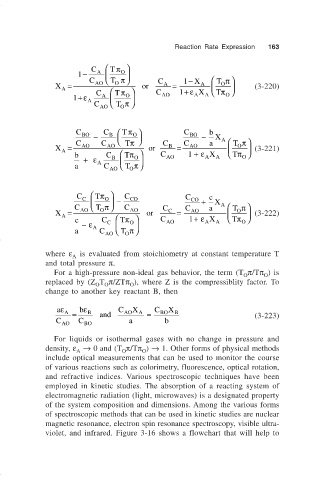
where ε is evaluated from stoichiometry at constant temperature T
A
and total pressure π.
For a high-pressure non-ideal gas behavior, the term (T π/Tπ ) is
O O
replaced by (Z T π/ZTπ ), where Z is the compressiblity factor. To
O O O
change to another key reactant B, then
aε A = bε B C AO X A = C BO X B
C AO C BO and a b (3-223)
For liquids or isothermal gases with no change in pressure and
density, ε → 0 and (T π/Tπ ) → 1. Other forms of physical methods
A O O
include optical measurements that can be used to monitor the course
of various reactions such as colorimetry, fluorescence, optical rotation,
and refractive indices. Various spectroscopic techniques have been
employed in kinetic studies. The absorption of a reacting system of
electromagnetic radiation (light, microwaves) is a designated property
of the system composition and dimensions. Among the various forms
of spectroscopic methods that can be used in kinetic studies are nuclear
magnetic resonance, electron spin resonance spectroscopy, visible ultra-
violet, and infrared. Figure 3-16 shows a flowchart that will help to

