


Page 149 -
P. 149
138                                                        M. Adams
                              “normal” specification of the host enactment engine, this method would already
                              be available within the engine.
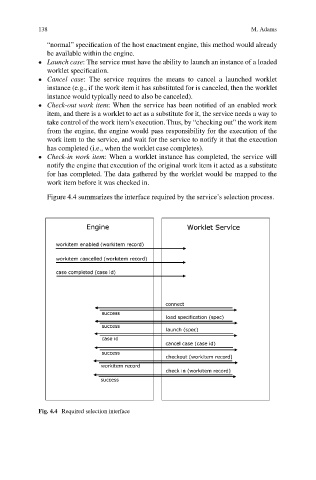
                             Launch case: The service must have the ability to launch an instance of a loaded
                              worklet specification.
                             Cancel case: The service requires the means to cancel a launched worklet
                              instance (e.g., if the work item it has substituted for is canceled, then the worklet
                              instance would typically need to also be canceled).
                             Check-out work item: When the service has been notified of an enabled work
                              item, and there is a worklet to act as a substitute for it, the service needs a way to
                              take control of the work item’s execution. Thus, by “checking out” the work item
                              from the engine, the engine would pass responsibility for the execution of the
                              work item to the service, and wait for the service to notify it that the execution
                              has completed (i.e., when the worklet case completes).
                             Check-in work item: When a worklet instance has completed, the service will
                              notify the engine that execution of the original work item it acted as a substitute
                              for has completed. The data gathered by the worklet would be mapped to the
                              work item before it was checked in.

                              Figure 4.4 summarizes the interface required by the service’s selection process.


                           Fig. 4.4 Required selection interface

