


Page 150 -
P. 150
4  Dynamic Workflow                                              139
                           4.8 Secondary Data Sources


                           When making a contextual choice of an appropriate worklet, it may be desirable or
                           even necessary to seek data outside the parameters of the task/or case. For example,
                           the current state of the process, or the states of individual tasks, may have some
                           bearing on the choices made; available resources may be an important factor and
                           so on. Thus, choosing the most appropriate worklet for a situation will be achieved
                           by defining rules that use a combination of currently available data attribute values,
                           both case-dependent and independent.
                              One method of accessing the current set of states for an instantiated process,
                           resource data, and archival histories of previous instantiations of a specification may
                           be deduced by mining the process log file. A series of predicates can be constructed
                           to enable the extraction of the current state set and any relations between active
                           worklets and tasks, as well as archival trends and relations. These predicates may
                           then be used to augment the conditionals in RDR nodes to enable selection of the
                           most appropriate worklet.
                              The kinds of information that may be extracted from the process log file using
                           these predicates include the current status of a worklet, whether a worklet is a parent
                           or child of another worklet, when a certain state was entered or exited for a particular
                           worklet or task, the resource that triggered a state change, and so on. Chapter 11
                           provides an explanation of how such predicates may be constructed and used in
                           practice.
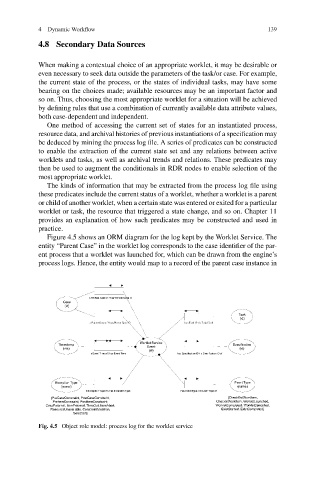
                              Figure 4.5 shows an ORM diagram for the log kept by the Worklet Service. The
                           entity “Parent Case” in the worklet log corresponds to the case identifier of the par-
                           ent process that a worklet was launched for, which can be drawn from the engine’s
                           process logs. Hence, the entity would map to a record of the parent case instance in


                           Fig. 4.5 Object role model: process log for the worklet service

