


Page 343 -
P. 343
12  The Declare Service                                         339


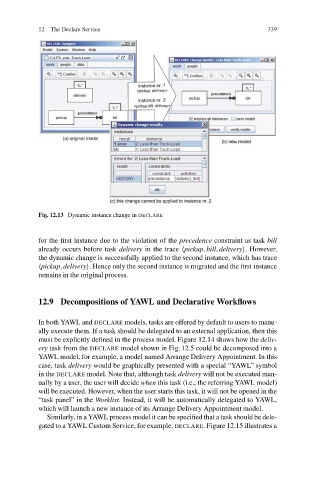
                           Fig. 12.13 Dynamic instance change in DECLARE


                           for the first instance due to the violation of the precedence constraint as task bill
                           already occurs before task delivery in the trace hpickup; bill; deliveryi.However,
                           the dynamic change is successfully applied to the second instance, which has trace
                           hpickup; deliveryi. Hence only the second instance is migrated and the first instance
                           remains in the original process.


                           12.9 Decompositions of YAWL and Declarative Workflows

                           In both YAWL and DECLARE models, tasks are offered by default to users to manu-
                           ally execute them. If a task should be delegated to an external application, then this
                           must be explicitly defined in the process model. Figure 12.14 shows how the deliv-
                           ery task from the DECLARE model shown in Fig. 12.5 could be decomposed into a
                           YAWL model, for example, a model named Arrange Delivery Appointment. In this
                           case, task delivery would be graphically presented with a special “YAWL” symbol
                           in the DECLARE model. Note that, although task delivery will not be executed man-
                           ually by a user, the user will decide when this task (i.e., the referring YAWL model)
                           will be executed. However, when the user starts this task, it will not be opened in the
                           “task panel” in the Worklist. Instead, it will be automatically delegated to YAWL,
                           which will launch a new instance of its Arrange Delivery Appointment model.
                              Similarly, in a YAWL process model it can be specified that a task should be dele-
                           gated to a YAWL Custom Service, for example, DECLARE. Figure 12.15 illustrates a

