


Page 350 -
P. 350
348                                                     G. Decket et al.
                           BPMN models) into “equivalent” process models defined in an executable language,
                           such as YAWL. Accordingly, this chapter will discuss relationships between BPMN
                           and YAWL, and will show how BPMN models can be transformed to YAWL
                           nets.
                              The remainder of this chapter is organized as follows. Section 13.2 introduces the
                           Business Process Modeling Notation (BPMN). Section 13.3 explains the transfor-
                           mation from BPMN models to YAWL nets, and Sect. 13.4 presents the tool support
                           that was developed to automate the transformation.


                           13.2 BPMN


                           This section explains BPMN by example, distinguishing control-flow, data manip-
                           ulation, resource management, and exception handling aspects. The presentation of
                           BPMN is meant to be didactical rather than exhaustive.


                           13.2.1 Control-Flow


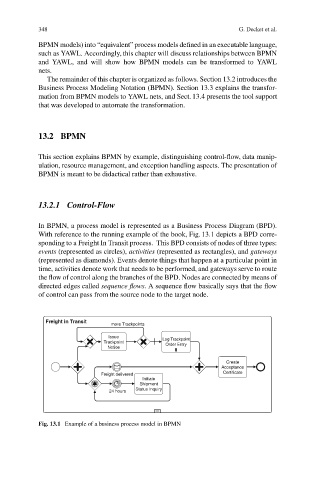
                           In BPMN, a process model is represented as a Business Process Diagram (BPD).
                           With reference to the running example of the book, Fig. 13.1 depicts a BPD corre-
                           sponding to a Freight In Transit process. This BPD consists of nodes of three types:
                           events (represented as circles), activities (represented as rectangles), and gateways
                           (represented as diamonds). Events denote things that happen at a particular point in
                           time, activities denote work that needs to be performed, and gateways serve to route
                           the flow of control along the branches of the BPD. Nodes are connected by means of
                           directed edges called sequence flows. A sequence flow basically says that the flow
                           of control can pass from the source node to the target node.


                             Freight in Transit
                                               more Trackpoints
                                               Issue          Log Trackpoint
                                             Trackpoint        Order Entry
                                              Notice

                                                                               Create
                                                                              Acceptance
                                                                               Certificate
                                             Freight delivered
                                                        Initiate
                                                       Shipment
                                                      Status Inquiry
                                               24 hours

                           Fig. 13.1 Example of a business process model in BPMN

