


Page 353 -
P. 353
13  The Business Process Modeling Notation                      351
                              There are several types of subprocesses in BPMN, including embedded subpro-
                           cess and independent subprocess. An embedded subprocess is part of the parent
                           process, while an independent subprocess exists independently of the parent pro-
                           cess. This chapter does not go into the details of these nuances and instead treats
                           both embedded and independent subprocesses equally.


                           13.2.2 Data

                           There are two ways in which the manipulation of data by processes and tasks can
                           be specified in BPMN: by means of data objects and by means of properties.
                              Data objects represent documents, data, or other objects that are used in the pro-
                           cess. They have a name and, optionally, a state. Data objects can be associated with
                           activities, showing that they are input for (by an arrow pointing to that task) or out-
                           put of that activity (by an arrow originating in that task). They can also be associated
                           with flows, showing that they are transferred from one activity to another via that
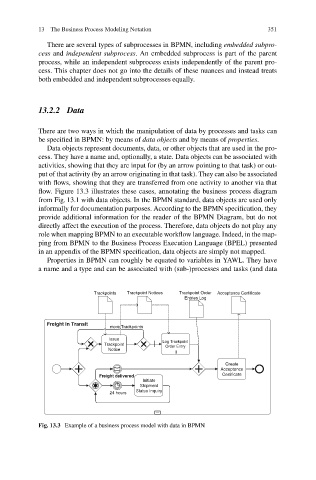
                           flow. Figure 13.3 illustrates these cases, annotating the business process diagram
                           from Fig. 13.1 with data objects. In the BPMN standard, data objects are used only
                           informally for documentation purposes. According to the BPMN specification, they
                           provide additional information for the reader of the BPMN Diagram, but do not
                           directly affect the execution of the process. Therefore, data objects do not play any
                           role when mapping BPMN to an executable workflow language. Indeed, in the map-
                           ping from BPMN to the Business Process Execution Language (BPEL) presented
                           in an appendix of the BPMN specification, data objects are simply not mapped.
                              Properties in BPMN can roughly be equated to variables in YAWL. They have
                           a name and a type and can be associated with (sub-)processes and tasks (and data


                                           Trackpoints  Trackpoint Notices  Trackpoint Order  Acceptance Certificate
                                                                    Entries Log


                              Freight in Transit
                                               more Trackpoints
                                               Issue
                                                              Log Trackpoint
                                              Trackpoint       Order Entry
                                               Notice
                                                                               Create
                                                                              Acceptance
                                            Freight delivered                 Certificate
                                                        Initiate
                                                       Shipment
                                               24 hours  Status Inquiry


                           Fig. 13.3 Example of a business process model with data in BPMN

