


Page 357 -
P. 357
13  The Business Process Modeling Notation                      355
                                 Ordering
                                                         Order not
                                                         approved
                                               Approve                 Confirm
                                       Create  Purchase
                                      Purchase  Order     Order        Purchase
                                       Order             approved       Order
                                                                       Modify
                                                                       Purchase
                                                                        Order


                                                             Order not  Order
                                                             approved  timed out
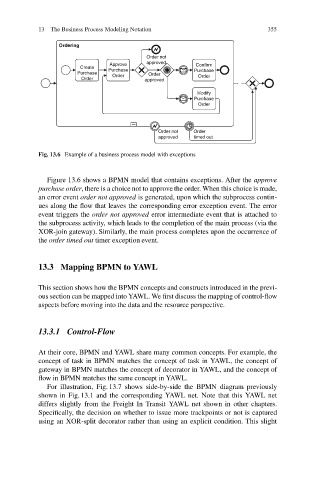
                           Fig. 13.6 Example of a business process model with exceptions


                              Figure 13.6 shows a BPMN model that contains exceptions. After the approve
                           purchase order, there is a choice not to approve the order. When this choice is made,
                           an error event order not approved is generated, upon which the subprocess contin-
                           ues along the flow that leaves the corresponding error exception event. The error
                           event triggers the order not approved error intermediate event that is attached to
                           the subprocess activity, which leads to the completion of the main process (via the
                           XOR-join gateway). Similarly, the main process completes upon the occurrence of
                           the order timed out timer exception event.


                           13.3 Mapping BPMN to YAWL

                           This section shows how the BPMN concepts and constructs introduced in the previ-
                           ous section can be mapped into YAWL. We first discuss the mapping of control-flow
                           aspects before moving into the data and the resource perspective.


                           13.3.1 Control-Flow


                           At their core, BPMN and YAWL share many common concepts. For example, the
                           concept of task in BPMN matches the concept of task in YAWL, the concept of
                           gateway in BPMN matches the concept of decorator in YAWL, and the concept of
                           flow in BPMN matches the same concept in YAWL.
                              For illustration, Fig. 13.7 shows side-by-side the BPMN diagram previously
                           shown in Fig. 13.1 and the corresponding YAWL net. Note that this YAWL net
                           differs slightly from the Freight In Transit YAWL net shown in other chapters.
                           Specifically, the decision on whether to issue more trackpoints or not is captured
                           using an XOR-split decorator rather than using an explicit condition. This slight

