


Page 362 -
P. 362
360                                                     G. Decket et al.
                                         pre-paid
                                         shipment  Issue Shipment
                                             Remittance Advice                 payment
                                                                      Issue Debit  incorrect
                                                                      Adjustment  (underpayment)
                                    Issue             Update Shipment
                                   Shipment           Payment Order
                                    Invoice                    not             payment
                                                               approved
                                                                               incorrect
                                                                               (overcharge)
                                             Issue Shipment  Approve Shipment  Process Shipment  Issue Credit
                                             Payment Order  Payment Order  Payment   Adjustment
                                                                 order
                                                                 approved
                                    invoice                                    payment
                                    required  Produce   Process Freight        correct
                                         Freight      Payment
                                         Invoice       +
                                                          Issue Shipment
                                                           Invoice
                                                                    Issue Shipment
                                               Issue Shipment   [else]  [pre-paid   Remittance
                                               Payment Order   shipments]  Advice  [invoice
                                                                              [else]
                                                                                   required]
                                     Update      Approve                            Produce Freight
                                                Shipment
                                    Shipment   Payment Order                          Invoice
                                   Payment Order
                                          [not approved]
                                                  [order approved]
                                                 Process
                                                Shipment
                                                Payment
                                       [payment incorrect  [payment   [payment  Process Freight
                                        (underpayment)]  incorrect  correct]   Payment
                                                (overcharge)]
                                     issue Debit
                                     Adjustment  Issue Credit
                                                Adjustment
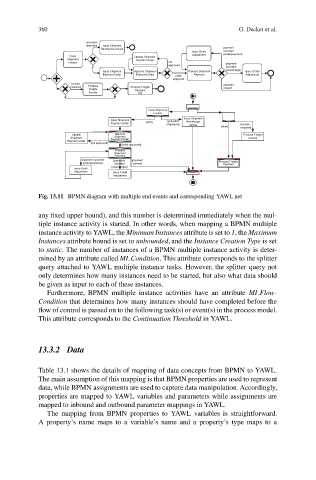
                           Fig. 13.11 BPMN diagram with multiple end events and corresponding YAWL net
                           any fixed upper bound), and this number is determined immediately when the mul-
                           tiple instance activity is started. In other words, when mapping a BPMN multiple
                           instance activity to YAWL, the Minimum Instances attribute is set to 1,the Maximum
                           Instances attribute bound is set to unbounded,and the Instance Creation Type is set
                           to static. The number of instances of a BPMN multiple instance activity is deter-
                           mined by an attribute called MI Condition. This attribute corresponds to the splitter
                           query attached to YAWL multiple instance tasks. However, the splitter query not
                           only determines how many instances need to be started, but also what data should
                           be given as input to each of these instances.
                              Furthermore, BPMN multiple instance activities have an attribute MI Flow-
                           Condition that determines how many instances should have completed before the
                           flow of control is passed on to the following task(s) or event(s) in the process model.
                           This attribute corresponds to the Continuation Threshold in YAWL.
                           13.3.2 Data
                           Table 13.1 shows the details of mapping of data concepts from BPMN to YAWL.
                           The main assumption of this mapping is that BPMN properties are used to represent
                           data, while BPMN assignments are used to capture data manipulation. Accordingly,
                           properties are mapped to YAWL variables and parameters while assignments are
                           mapped to inbound and outbound parameter mappings in YAWL.
                              The mapping from BPMN properties to YAWL variables is straightforward.
                           A property’s name maps to a variable’s name and a property’s type maps to a

