


Page 270 - Modern Derivatization Methods for Separation Sciences
P. 270
Document                                                                                Página 1 de 2


                                                                                                         Page 127


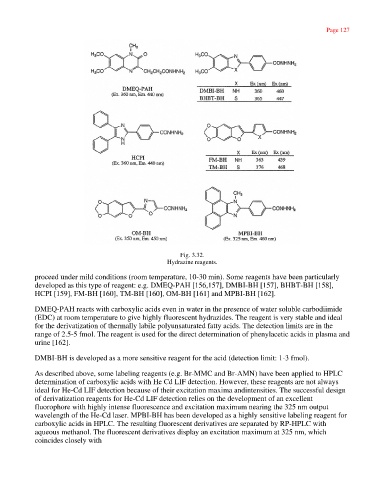
                                                          Fig. 3.32.
                                                      Hydrazine reagents.

            proceed under mild conditions (room temperature, 10-30 min). Some reagents have been particularly
            developed as this type of reagent: e.g. DMEQ-PAH [156,157], DMBI-BH [157], BHBT-BH [158],
            HCPI [159], FM-BH [160], TM-BH [160], OM-BH [161] and MPBI-BH [162].

            DMEQ-PAH reacts with carboxylic acids even in water in the presence of water soluble carbodiimide
            (EDC) at room temperature to give highly fluorescent hydrazides. The reagent is very stable and ideal
            for the derivatization of thermally labile polyunsaturated fatty acids. The detection limits are in the
            range of 2.5-5 fmol. The reagent is used for the direct determination of phenylacetic acids in plasma and
            urine [162].

            DMBI-BH is developed as a more sensitive reagent for the acid (detection limit: 1-3 fmol).

            As described above, some labeling reagents (e.g. Br-MMC and Br-AMN) have been applied to HPLC
            determination of carboxylic acids with He Cd LIF detection. However, these reagents are not always
            ideal for He-Cd LIF detection because of their excitation maxima andintensities. The successful design
            of derivatization reagents for He-Cd LIF detection relies on the development of an excellent
            fluorophore with highly intense fluorescence and excitation maximum nearing the 325 nm output
            wavelength of the He-Cd laser. MPBI-BH has been developed as a highly sensitive labeling reagent for
            carboxylic acids in HPLC. The resulting fluorescent derivatives are separated by RP-HPLC with
            aqueous methanol. The fluorescent derivatives display an excitation maximum at 325 nm, which
            coincides closely with


            http://emedia.netlibrary.com/nlreader/nlreader.dll?bookid=17968&filename=Page_127.ht...   30/09/2003

