


Page 378 - MODERN ELECTROCHEMISTRY
P. 378
314     CHAPTER 3

           3.8.5.  Activity Coefficients, Bjerrum’s Ion Pairs, and Debye’s Free Ions

               What direct role do the ion pairs have in the Debye–Hückel electrostatic theory
           of activity coefficients? The answer is simply: None. Since ion pairs carry no net
                 23
           charge,  they  are ineligible for membership in the ion cloud,  where the essential
           qualification is charge. Hence, ion pairs are dismissed from a direct consideration in
           the Debye–Hückel theory.
               This does not mean that the Debye–Hückel theory gives the right answer when
           there is ion-pair formation. The extent of ion-pair formation decides the value of the
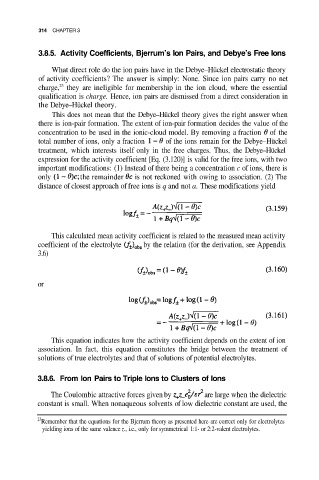
           concentration to be used in the ionic-cloud model. By removing a fraction  of the
           total number of ions, only a fraction    of the ions remain for the Debye–Hückel
           treatment, which  interests  itself only  in  the free charges.  Thus,  the Debye–Hückel
           expression for the activity coefficient [Eq. (3.120)] is valid for the free ions, with two
           important modifications: (1) Instead of there being a concentration c of ions, there is
           only        the  remainder  is  not  reckoned with owing to association. (2) The
           distance of closest approach of free ions is q and not a. These modifications yield


               This calculated mean activity coefficient is related to the measured mean activity
           coefficient of the electrolyte   by the relation (for the derivation, see Appendix
           3.6)


           or


               This equation indicates how the activity coefficient depends on the extent of ion
           association. In  fact, this  equation constitutes the  bridge between  the treatment of
           solutions of true electrolytes and that of solutions of potential electrolytes.

           3.8.6. From Ion Pairs to Triple Ions to Clusters of Ions

               The Coulombic attractive forces given by   are large when the dielectric
           constant is small. When nonaqueous solvents of low dielectric constant are used, the
           23
            Remember that the equations for the Bjerrum theory as presented here are correct only for electrolytes
            yielding ions of the same valence z., i.e., only for symmetrical 1:1- or 2:2-valent electrolytes.

