


Page 379 - MODERN ELECTROCHEMISTRY
P. 379
ION–ION INTERACTIONS 315

           values of dielectric constant are small. In such solutions of electrolytes therefore it has
           already been stated that ion-pair formation is favored.
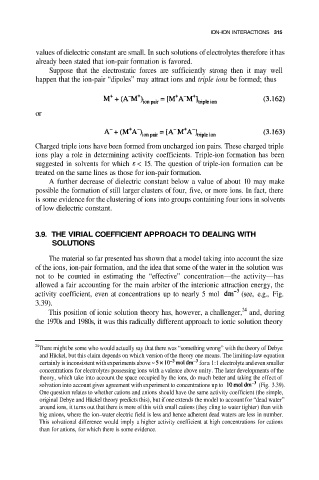
              Suppose  that the  electrostatic forces  are  sufficiently  strong then  it  may  well
           happen that the ion-pair “dipoles” may attract ions and triple ions be formed; thus


           or


           Charged triple ions have been formed from uncharged ion pairs. These charged triple
           ions play  a role in determining activity coefficients. Triple-ion formation has been
           suggested in  solvents for which  < 15. The question of triple-ion formation can be
           treated on the same lines as those for ion-pair formation.
              A further decrease of dielectric constant below a value of about 10 may make
           possible the formation of still larger clusters of four, five, or more ions. In fact, there
           is some evidence for the clustering of ions into groups containing four ions in solvents
           of low dielectric constant.


           3.9. THE VIRIAL COEFFICIENT APPROACH TO DEALING WITH
               SOLUTIONS

              The material so far presented has shown that a model taking into account the size
           of the ions, ion-pair formation, and the idea that some of the water in the solution was
           not to  be counted  in estimating the “effective”  concentration—the  activity—has
           allowed a fair accounting for the main arbiter of the interionic attraction energy, the
           activity coefficient, even at concentrations up to nearly 5 mol    (see, e.g., Fig.
           3.39).
                                                                  24
              This position of ionic solution theory has, however, a challenger,  and, during
           the 1970s and 1980s, it was this radically different approach to ionic solution theory


           24
           There might be some who would actually say that there was “something wrong” with the theory of Debye
            and Hückel, but this claim depends on which version of the theory one means. The limiting-law equation
            certainly is inconsistent with experiments above   for a 1:1 electrolyte and even smaller
            concentrations for electrolytes possessing ions with a valence above unity. The later developments of the
            theory, which take into account the space occupied by the ions, do much better and taking the effect of
            solvation into account gives agreement with experiment to concentrations up to     (Fig. 3.39).
            One question relates to whether cations and anions should have the same activity coefficient (the simple,
            original Debye and Hückel theory predicts this), but if one extends the model to account for “dead water”
            around ions, it turns out that there is more of this with small cations (they cling to water tighter) than with
            big anions, where the ion–water electric field is less and hence adherent dead waters are less in number.
            This solvational difference would imply a higher activity coefficient at high concentrations for cations
            than for anions, for which there is some evidence.

