


Page 384 - MODERN ELECTROCHEMISTRY
P. 384
320  CHAPTER 3


           where r is the interparticle distance and A and B are constants, the values of which are
           not usually  found  from  independent determinations but  by  assuming the law  of
           interaction calculation procedure to be correct and finding the A’s and B’s that have
           then to be used to fit the experimental quantities.
              What is the procedure? The N particles are started off in any configuration, e.g.,
           in that of a regular lattice. Then each particle is moved randomly (hence the title of
           the procedure). A single but vital question is asked about each move: does it increase
          the energy of the particle (make its potential energy move positive) or decrease it
           (potential energy more negative)? If the former, the move is not counted as contribut-
           ing to the final equilibrium stage of the system. If the latter, it is counted.
              Such a calculation is then carried out successively on each particle many times.
           Since each can move to any point within the allotted space, a large enough number of
          moves  allows one to reach the equilibrium state of the system while calculating a
          targeted quantity, e.g., the pressure of an imperfect gas. The result is compared with
          that known experimentally, thus confirming or denying the force law assumed (and
          other assumptions implicit in the calculation).
              Card and Valleau  (1970)  were the first to  apply the Metropolis  Monte Carlo
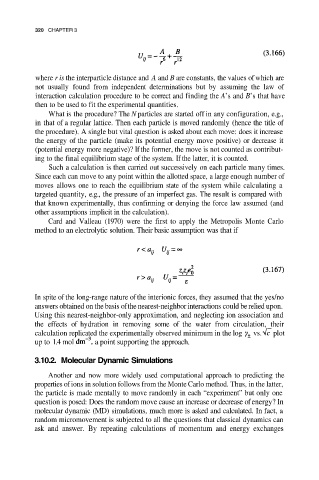
          method to an electrolytic solution. Their basic assumption was that if


          In spite of the long-range nature of the interionic forces, they assumed that the yes/no
          answers obtained on the basis of the nearest-neighbor interactions could be relied upon.
          Using this nearest-neighbor-only approximation, and neglecting ion association and
          the effects of  hydration in  removing some  of  the  water  from  circulation, their
          calculation replicated the experimentally observed minimum in the log   vs.  plot
          up to 1.4 mol    a point supporting the approach.

          3.10.2.  Molecular Dynamic Simulations

              Another and  now more widely used computational approach to predicting the
          properties of ions in solution follows from the Monte Carlo method. Thus, in the latter,
          the particle is made mentally to move randomly in each “experiment” but only one
          question is posed: Does the random move cause an increase or decrease of energy? In
          molecular dynamic (MD) simulations, much more is asked and calculated. In fact, a
          random micromovement is subjected to all the questions that classical dynamics can
          ask and  answer.  By repeating  calculations of momentum and energy  exchanges

