


Page 385 - MODERN ELECTROCHEMISTRY
P. 385
ION–ION INTERACTIONS 321


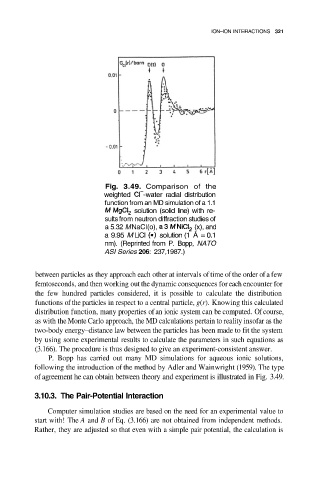
                             Fig.  3.49. Comparison  of  the
                             weighted   -water  radial  distribution
                             function from an MD simulation of a 1.1
                                     solution (solid line) with re-
                             sults from neutron diffraction studies of
                             a 5.32 M NaCI(o),        (x), and
                             a 9.95 M LiCI   solution (1 Å = 0.1
                             nm). (Reprinted from P. Bopp, NATO
                             ASI Series 206: 237,1987.)


           between particles as they approach each other at intervals of time of the order of a few
           femtoseconds, and then working out the dynamic consequences for each encounter for
           the few  hundred  particles  considered, it  is possible  to  calculate the distribution
           functions of the particles in respect to a central particle, g(r). Knowing this calculated
          distribution function, many properties of an ionic system can be computed. Of course,
           as with the Monte Carlo approach, the MD calculations pertain to reality insofar as the
          two-body energy–distance law between the particles has been made to fit the system
          by using some experimental results to calculate the parameters in such equations as
          (3.166). The procedure is thus designed to give an experiment-consistent answer.
              P. Bopp  has  carried out  many  MD simulations for aqueous  ionic solutions,
          following the introduction of the method by Adler and Wainwright (1959). The type
          of agreement he can obtain between theory and experiment is illustrated in Fig. 3.49.

          3.10.3. The Pair-Potential Interaction

              Computer simulation studies are based on the need for an experimental value to
          start with! The A and B of Eq. (3.166) are not obtained from independent methods.
          Rather, they are adjusted so that even with a simple pair potential, the calculation is

