


Page 347 - Modern Optical Engineering The Design of Optical Systems
P. 347
326   Chapter Thirteen

        the size of the image without changing the image location. The com-
        ponent powers of this type of system can be determined from Eqs. 4.9
        and 4.10 by setting the object to image distance T (the “track length”)
        equal to zero. (Note that the arrangement shown here is usually much
        more satisfactory than that with the component powers reversed,
        which reduces the image size.)
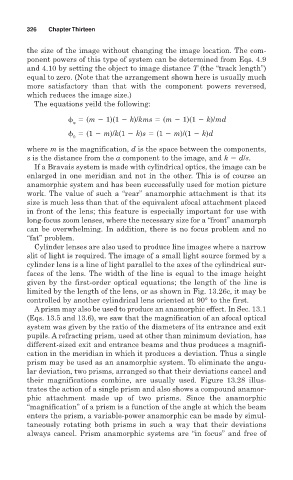
          The equations yeild the following:

                       (m   1)(1   k)/kms   (m   1)(1   k)/md
                     a
                       (1   m)/k(1   k)s   (1   m)/(1   k)d
                     b
        where m is the magnification, d is the space between the components,
        s is the distance from the a component to the image, and k   d/s.
          If a Bravais system is made with cylindrical optics, the image can be
        enlarged in one meridian and not in the other. This is of course an
        anamorphic system and has been successfully used for motion picture
        work. The value of such a “rear” anamorphic attachment is that its
        size is much less than that of the equivalent afocal attachment placed
        in front of the lens; this feature is especially important for use with
        long-focus zoom lenses, where the necessary size for a “front” anamorph
        can be overwhelming. In addition, there is no focus problem and no
        “fat” problem.
          Cylinder lenses are also used to produce line images where a narrow
        slit of light is required. The image of a small light source formed by a
        cylinder lens is a line of light parallel to the axes of the cylindrical sur-
        faces of the lens. The width of the line is equal to the image height
        given by the first-order optical equations; the length of the line is
        limited by the length of the lens, or as shown in Fig. 13.26c, it may be
        controlled by another cylindrical lens oriented at 90° to the first.
          A prism may also be used to produce an anamorphic effect. In Sec. 13.1
        (Eqs. 13.5 and 13.6), we saw that the magnification of an afocal optical
        system was given by the ratio of the diameters of its entrance and exit
        pupils. A refracting prism, used at other than minimum deviation, has
        different-sized exit and entrance beams and thus produces a magnifi-
        cation in the meridian in which it produces a deviation. Thus a single
        prism may be used as an anamorphic system. To eliminate the angu-
        lar deviation, two prisms, arranged so that their deviations cancel and
        their magnifications combine, are usually used. Figure 13.28 illus-
        trates the action of a single prism and also shows a compound anamor-
        phic attachment made up of two prisms. Since the anamorphic
        “magnification” of a prism is a function of the angle at which the beam
        enters the prism, a variable-power anamorphic can be made by simul-
        taneously rotating both prisms in such a way that their deviations
        always cancel. Prism anamorphic systems are “in focus” and free of

