


Page 108 - Modern physical chemistry
P. 108
98                         Entropy and the Second Law

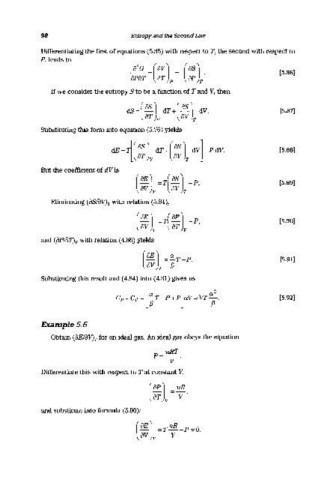
             Differentiating the first of equations (5.85) with respect to T, the second with respect to
                                        a~:T = [ ~~ l -[ ;! l·                       [5.86J
             P, leads to

                                                      =
                If we consider the entropy S to be a function of T and V, then

                                       dS=(as)  dT+[as)  dV.                         [5.87J
                                             aT  v     av  T

             Substituting this form into equation (5.76) yields
                                   dE~~[:nv dT+[:a dV]-PdV                           [5.88J


             But the coefficient of dV is
                                          [~~l =T( ;~ l-p·                           [5.89J


                Eliminating (aS/aV)T with relation (5.84),

                                          ( aE)  = T(ap)  _P,                        [5.90J
                                           av  T     aT  v
             and (aPlaT)v with relation (4.86) yields

                                            [;~lT =;T-P.                             [5.91 J


             Substituting this result and (4.84) into (4.81) gives us

                                                                                     [5.92J


             Example 5.6
                Obtain (aElaV)T for an ideal gas. An ideal gas obeys the equation
                                               P= nRT.

                                                    V
             Differentiate this with respect to T at constant V,
                                                      nR

                                                      V'

             and substitute into formula (5.90):


                                          [ ;~ l = T n; -P = o.

