


Page 104 - Modern physical chemistry
P. 104
94                         Entropy and the Second Law

             The number of states Wequals the product of the state numbers for the parts:
                                               W=WcWo·                               [5.48J

             We presume that each entropy depends only on the corresponding state number:
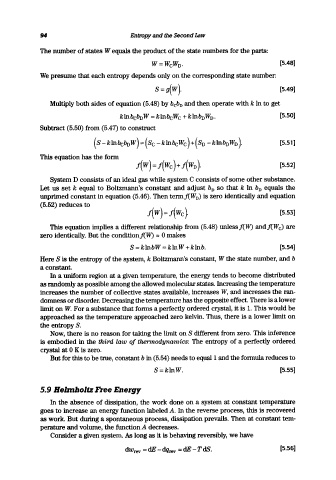
                                                                                     [5.49J

                Multiply both sides of equation (5.48) by bcbo and then operate with k In to get
                                     klnbcboW = klnbcWc + klnboWo·                   [5.50J
             Subtract (5.50) from (5.47) to construct

                             (S-klnbcboW)=(Sc -klnbcW c )+(So -klnboWo).             [5.51 J

             This equation has the form
                                                                                     [5.52J

                System D consists of an ideal gas while system C consists of some other substance.
             Let us set k  equal to Boltzmann's constant and adjust bo so that k  In bo equals the
             unpriroed constant in equation (5.46). Then termfl:Wo) is zero identically and equation
             (5.52) reduces to
                                                                                     [5.53J

                This equation implies a different relationship from (5.48) unless.f(W) and.f(Wc) are
             zero identically. But the condition.f(W) = 0 makes

                                        S = klnbW = kln W + klnb.                    [5.54J
             Here S is the entropy of the system, k Boltzmann's constant, W the state number, and b
             a constant.
                In a uniform region at a given temperature, the energy tends to become distributed
             as randomly as possible among the allowed molecular states. Increasing the temperature
             increases the number of collective states available, increases W,  and increases the ran-
             domness or disorder. Decreasing the temperature has the opposite effect. There is a lower
             limit on W.  For a substance that forms a perfectly ordered crystal, it is 1. This would be
             approached as the temperature approached zero kelvin. Thus, there is a lower limit on
             the entropy S.
                Now, there is no reason for taking the limit on S different from zero. This inference
             is embodied in the third law of thermodynamics: The entropy of a perfectly ordered
             crystal at 0 K is zero.
                But for this to be true, constant b in (5.54) needs to equal! and the formula reduces to

                                               S=klnW.                               [5.55J

             5.9 Helmholtz Free Energy

                In the absence of dissipation, the work done on a system at constant temperature
             goes to increase an energy function labeled A. In the reverse process, this is recovered
             as work. But during a spontaneous process, dissipation prevails. Then at constant tem-
             perature and volume, the function A decreases.
                Consider a given system. As long as it is behaving reversibly, we have

                                       dWrev =dE-dqrev =dE-TdS.                      [5.56J

