


Page 115 - Modern physical chemistry
P. 115
References                              105

             5.15  Calculate the entropy of vaporization of acetic acid at its boiling point, 118.2° C, where its
                   heat of vaporization is 24,390 J mo!"l.
             5.16  An insulated 15.0 ohm resistor initially at 0° C carries a current of 10.0 amp for 1.00 s. If the
                   mass of the resistor is 5.00 g and its specific heat 0.200, what is its entropy change?
             5.17  After 10.0 g ice at 0° C is added to 65.0 g water at 45° C, the ice melts and equilibrium is set
                   up without interchange of heat with the surroundings. If the heat of fusion of ice is 333.5 J
                   g-I and the specific heat of water is 1.000, what is the total entropy change in the process?
             5.18  An insulated flask  containing 1000 g liquid water at -3.8° C is disturbed so that freezing
                   occurs until equilibrium is established. What is the total entropy change?
             5.19  If 25.0 g water evaporates at 100° C, where its heat of vaporization is 2254 J g-I, and mixes
                   with 25.0 g nitrogen at 100° C and 1.00 atm, what is the entropy change?
             5.20  For water at 25° C the coefficient of cubical expansion a is 2.1  x lO-4KI and the compress-
                  ibility coefficient f3 4.9 x 10"6 atm· l . What is dS when the pressure on 1.00 mol H 20 is increased
                  from 1.00 to 20.0 atm at 25° C?
              5.21  Calculate Cp  - Cv for water at 25° C .
             5.22  For a condensed phase, determine (a) (iJHliJP)."  (b) (iJHliJV)." and (c) (iJV/iJT)s
             5.23  With a result from problem 5.22,  calculate dB when 1.000 mol water is compressed at 25°
                  C from 1.00 to 20.0 atm.
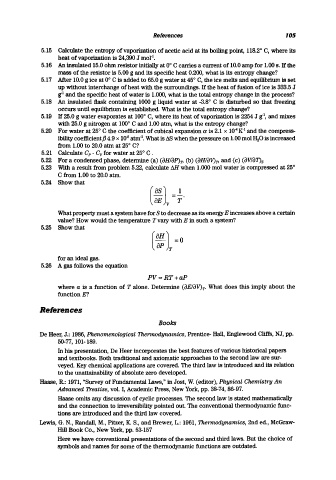
             5.24  Show that
                                                       1
                                                      T
                  What property must a system have for S to decrease as its energy E increases above a certain
                  value? How would the temperature T vary with E in such a system?
             5.25  Show that
                                               ( OH)  =0
                                                oP  T
                  for an ideal gas.
             5.26  A gas follows the equation
                                             PV=RT+aP
                  where a is a function of T alone.  Determine (iJEliJV)l"  What does this imply about the
                  functionE?

             References

                                                 Books
             De Heer, J.: 1986, Phenomenological Thernwdynamics, Prentice- Hall, Englewood Cliffs, NJ, pp.
                  50-77,  101-189.
                  In his presentation, De Heer incorporates the best features of various historical papers
                  and textbooks. Both traditional and axiomatic approaches to the second law are sur-
                  veyed. Key chemical applications are covered. The third law is introduced and its relation
                  to the unattainability of absolute zero developed.
             Haase, R.:  1971, "Survey of Fundamental Laws," in Jost, W.  (editor), Physical Chemistry An
                  Advanced Treatise, vol. I, Academic Press, New York, pp. 38-74, 86-97.
                  Haase omits any discussion of cyclic processes. The second law is stated mathematically
                  and the connection to irreversibility pointed out. The conventional thermodynamic func-
                  tions are introduced and the third law covered.
             Lewis, G. N., Randall, M.,  Pitzer, K. S., and Brewer, L.:  1961, Thermodynamics, 2nd ed., McGraw-
                  Hill Book Co., New York, pp. 53-157
                  Here we have conventional presentations of the second and third laws. But the choice of
                  symbols and names for some of the thermodynamic functions are outdated.

