


Page 255 - Modular design for machine tools
P. 255
Engineering Design Fundamentals and Single Flat Joint Characteristics        215

                  b. In the case of K < K , the joint surface is, in general, liable to sep-
                                   0
                                       j
                     arate, and consequently the joint doesn’t show any linear defor-
                     mation across the whole joint surface, resulting in the nonuniform
                     or nonlinear interface pressure distribution. As can be seen, we can
                     observe this kind at the bolted joint.
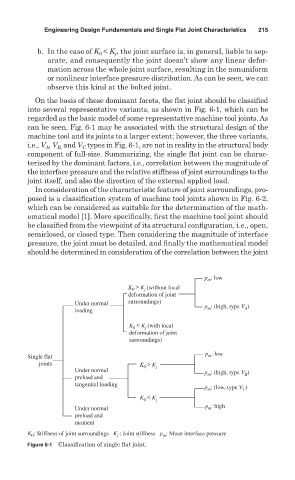
                 On the basis of these dominant facets, the flat joint should be classified
               into several representative variants, as shown in Fig. 6-1, which can be
               regarded as the basic model of some representative machine tool joints. As
               can be seen, Fig. 6-1 may be associated with the structural design of the
               machine tool and its joints to a larger extent; however, the three variants,
               i.e., V , V and V types in Fig. 6-1, are not in reality in the structural body
                    A
                              C
                       B,
               component of full-size. Summarizing, the single flat joint can be charac-
               terized by the dominant factors, i.e., correlation between the magnitude of
               the interface pressure and the relative stiffness of joint surroundings to the
               joint itself, and also the direction of the external applied load.
                 In consideration of the characteristic feature of joint surroundings, pro-
               posed is a classification system of machine tool joints shown in Fig. 6-2,
               which can be considered as suitable for the determination of the math-
               ematical model [1]. More specifically, first the machine tool joint should
               be classified from the viewpoint of its structural configuration, i.e., open,
               semiclosed, or closed type. Then considering the magnitude of interface
               pressure, the joint must be detailed, and finally the mathematical model
               should be determined in consideration of the correlation between the joint


                                                                 : low
                                                               p m
                                           K > K (without local
                                               j
                                            0
                                           deformation of joint
                            Under normal   surroundings)
                                                               p m : (high, type V )
                                                                          A
                            loading
                                           K < K (with local
                                               j
                                            0
                                           deformation of joint
                                           surroundings)
                                                               p : low
               Single flat                                      m
                  joints                      K > K j
                                               0
                            Under normal
                                                                          B
                                                               p m : (high, type V )
                            preload and
                            tangential loading
                                                               p : (low, type V )
                                                                m
                                                                         C
                                              K < K j
                                               0
                            Under normal                       p : high
                                                                m
                            preload and
                            moment
               K : Stiffness of joint surroundings   K : Joint stiffness   p : Mean interface pressure
                                        j
                                                    m
                0
               Figure 6-1 Classification of single flat joint.

