


Page 376 - Multidimensional Chromatography
P. 376
Multidimensional Chromatography in Environmental Analysis       367


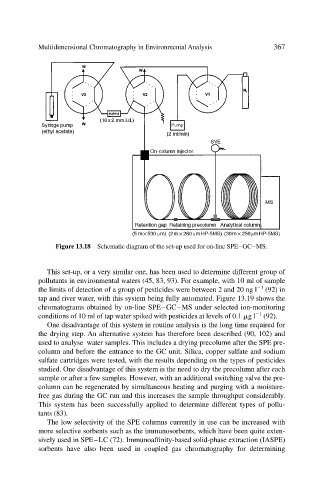
                                Figure 13.18 Schematic diagram of the set-up used for on-line SPE–GC–MS.


                              This set-up, or a very similar one, has been used to determine different group of
                           pollutants in environmental waters (45, 83, 93). For example, with 10 ml of sample
                           the limits of detection of a group of pesticides were between 2 and 20 ng l  1  (92) in
                           tap and river water, with this system being fully automated. Figure 13.19 shows the
                           chromatograms obtained by on-line SPE–GC–MS under selected ion-monitoring
                           conditions of 10 ml of tap water spiked with pesticides at levels of 0.1  g l  1  (92).
                              One disadvantage of this system in routine analysis is the long time required for
                           the drying step. An alternative system has therefore been described (90, 102) and
                           used to analyse  water samples. This includes a drying precolumn after the SPE pre-
                           column and before the entrance to the GC unit. Silica, copper sulfate and sodium
                           sulfate cartridges were tested, with the results depending on the types of pesticides
                           studied. One disadvantage of this system is the need to dry the precolumn after each
                           sample or after a few samples. However, with an additional switching valve the pre-
                           column can be regenerated by simultaneous heating and purging with a moisture-
                           free gas during the GC run and this increases the sample throughput considerably.
                           This system has been successfully applied to determine different types of pollu-
                           tants (83).
                              The low selectivity of the SPE columns currently in use can be increased with
                           more selective sorbents such as the immunosorbents, which have been quite exten-
                           sively used in SPE–LC (72). Immunoaffinity-based solid-phase extraction (IASPE)
                           sorbents have also been used in coupled gas chromatography for determining

