


Page 158 - New Trends In Coal Conversion
P. 158
Coal and biomass cofiring: fundamentals and future trends          121

           dictates the amount of air required for combustion (stoichiometry), and if less air is
           required, less nonreacting components of the air (mostly N 2 ) need to be heated to
           the flame temperature (Madanayake et al., 2017). The higher O content of biomass
           means that less air is required for combustion, compared with typical hydrocarbon
           fuels (Jenkins et al., 1998). Hence, biomass fuels have the potential to achieve higher
           combustion efficiencies compared with other hydrocarbon fuels. The higher volatility
           of biomass improves its reactivity and ignition characteristics compared with coal, and
           this usually results in a lower activation energy barrier to devolatilization and oxidation
           (Agbor et al., 2014).


           5.3   Coal and biomass cofiring technologies

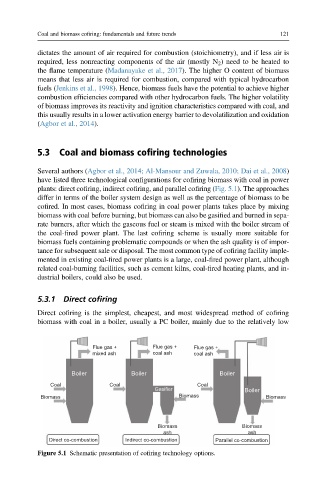
           Several authors (Agbor et al., 2014; Al-Mansour and Zuwala, 2010; Dai et al., 2008)
           have listed three technological configurations for cofiring biomass with coal in power
           plants: direct cofiring, indirect cofiring, and parallel cofiring (Fig. 5.1). The approaches
           differ in terms of the boiler system design as well as the percentage of biomass to be
           cofired. In most cases, biomass cofiring in coal power plants takes place by mixing
           biomass with coal before burning, but biomass can also be gasified and burned in sepa-
           rate burners, after which the gaseous fuel or steam is mixed with the boiler stream of
           the coal-fired power plant. The last cofiring scheme is usually more suitable for
           biomass fuels containing problematic compounds or when the ash quality is of impor-
           tance for subsequent sale or disposal. The most common type of cofiring facility imple-
           mented in existing coal-fired power plants is a large, coal-fired power plant, although
           related coal-burning facilities, such as cement kilns, coal-fired heating plants, and in-
           dustrial boilers, could also be used.


           5.3.1  Direct cofiring
           Direct cofiring is the simplest, cheapest, and most widespread method of cofiring
           biomass with coal in a boiler, usually a PC boiler, mainly due to the relatively low


                          Flue gas +      Flue gas +  Flue gas +
                          mixed ash       coal ash   coal ash


                    Boiler           Boiler                 Boiler
               Coal            Coal                   Coal
                                           Gasifier                Boiler
            Biomass                              Biomass                 Biomass


                                            Biomass               Biomass
                                             ash                    ash
              Direct co-combustion  Indirect co-combustion  Parallel co-combustion
           Figure 5.1 Schematic presentation of cofiring technology options.

