


Page 164 - New Trends In Coal Conversion
P. 164
Coal and biomass cofiring: fundamentals and future trends          127


               35
                                           Coal               Coal (anthracite)
               30
                                                              Solid wood
              Energy density (GJ/m 3 )  20  Raw biomass  Processed biomass  Sawdust
                                                              Wood chips
               25
                                                              Black liquor
                                                              Wood pellets
               15
                                                              Torrefied wood pellets
               10
                                                              Straw (baled)
                5                                             Pyrolysis oil
                                                              Organic waste
                0
                  0            500          1000         1500
                                             3
                               Bulk density (kg/m )
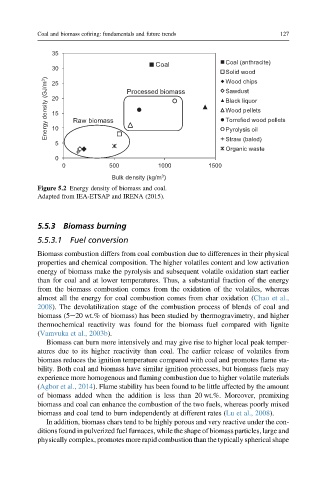
           Figure 5.2 Energy density of biomass and coal.
           Adapted from IEA-ETSAP and IRENA (2015).


           5.5.3  Biomass burning
           5.5.3.1  Fuel conversion
           Biomass combustion differs from coal combustion due to differences in their physical
           properties and chemical composition. The higher volatiles content and low activation
           energy of biomass make the pyrolysis and subsequent volatile oxidation start earlier
           than for coal and at lower temperatures. Thus, a substantial fraction of the energy
           from the biomass combustion comes from the oxidation of the volatiles, whereas
           almost all the energy for coal combustion comes from char oxidation (Chao et al.,
           2008). The devolatilization stage of the combustion process of blends of coal and
           biomass (5e20 wt.% of biomass) has been studied by thermogravimetry, and higher
           thermochemical reactivity was found for the biomass fuel compared with lignite
           (Vamvuka et al., 2003b).
              Biomass can burn more intensively and may give rise to higher local peak temper-
           atures due to its higher reactivity than coal. The earlier release of volatiles from
           biomass reduces the ignition temperature compared with coal and promotes flame sta-
           bility. Both coal and biomass have similar ignition processes, but biomass fuels may
           experience more homogenous and flaming combustion due to higher volatile materials
           (Agbor et al., 2014). Flame stability has been found to be little affected by the amount
           of biomass added when the addition is less than 20 wt.%. Moreover, premixing
           biomass and coal can enhance the combustion of the two fuels, whereas poorly mixed
           biomass and coal tend to burn independently at different rates (Lu et al., 2008).
              In addition, biomass chars tend to be highly porous and very reactive under the con-
           ditions found in pulverized fuel furnaces, while the shape of biomass particles, large and
           physically complex, promotes more rapid combustion than the typically spherical shape

