


Page 167 - New Trends In Coal Conversion
P. 167
130                                            New Trends in Coal Conversion


                               Secondary air


                                   Fuel


                                  Primary air


                                                 Ash
                                        Grated combustor
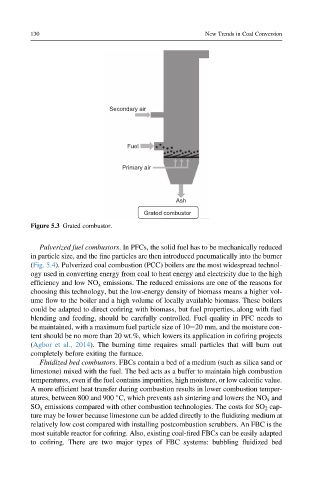
         Figure 5.3 Grated combustor.

            Pulverized fuel combustors. In PFCs, the solid fuel has to be mechanically reduced
         in particle size, and the fine particles are then introduced pneumatically into the burner
         (Fig. 5.4). Pulverized coal combustion (PCC) boilers are the most widespread technol-
         ogy used in converting energy from coal to heat energy and electricity due to the high
         efficiency and low NO x emissions. The reduced emissions are one of the reasons for
         choosing this technology, but the low-energy density of biomass means a higher vol-
         ume flow to the boiler and a high volume of locally available biomass. These boilers
         could be adapted to direct cofiring with biomass, but fuel properties, along with fuel
         blending and feeding, should be carefully controlled. Fuel quality in PFC needs to
         be maintained, with a maximum fuel particle size of 10e20 mm, and the moisture con-
         tent should be no more than 20 wt.%, which lowers its application in cofiring projects
         (Agbor et al., 2014). The burning time requires small particles that will burn out
         completely before exiting the furnace.
            Fluidized bed combustors. FBCs contain a bed of a medium (such as silica sand or
         limestone) mixed with the fuel. The bed acts as a buffer to maintain high combustion
         temperatures, even if the fuel contains impurities, high moisture, or low calorific value.
         A more efficient heat transfer during combustion results in lower combustion temper-

         atures, between 800 and 900 C, which prevents ash sintering and lowers the NO x and
         SO x emissions compared with other combustion technologies. The costs for SO 2 cap-
         ture may be lower because limestone can be added directly to the fluidizing medium at
         relatively low cost compared with installing postcombustion scrubbers. An FBC is the
         most suitable reactor for cofiring. Also, existing coal-fired FBCs can be easily adapted
         to cofiring. There are two major types of FBC systems: bubbling fluidized bed

