


Page 202 - New Trends In Coal Conversion
P. 202
Technologies for control of sulfur and nitrogen compounds and particulates  165

           compounds. Halogens are converted into their acids. Coal also contains other reactive
           or easily vaporized elements such as beryllium, arsenic, selenium, cadmium, mercury,
           and lead (Benson et al., 1995).
              The primary objective of gas cleaning in combined-cycle systems is to protect the
           gas turbine from deposition, erosion, and corrosion by impurities such as particulates,
           alkali metals (sodium and potassium), and heavy trace metals (such as lead and vana-
           dium). The acceptable limit for particulate entering a gas turbine is significantly lower
           than current emission standards (typically by a factor of 10 or more), with additional
           concentration limits set for particles greater than 2 mm. The secondary objective is to
           ensure that existing environmental emission requirements are met, particularly for N, S
           compounds and particulates (McConville, 1997).


           6.3.1  Conventional gas cleaning in IGCC

           The main components of IGCC are coal gasification, raw gas cooling, syngas cleaning,
           and power generation block. IGCC systems that use coal as fuel incorporate high-

           temperature gasification systems (between 1300 and 1400 C) to favor the conversion

           to syngas. Before its cleaning, the raw gas is cooled to around 200e250 C
           (Wolfersdorf and Meyer, 2017; Kosstrin, 2017). Depending on the particle removal
           system, there are two main alternatives with respect to the first stage of the syngas
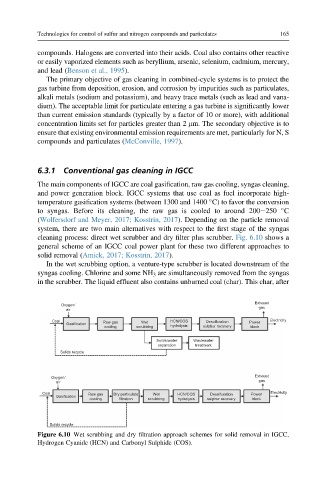
           cleaning process: direct wet scrubber and dry filter plus scrubber. Fig. 6.10 shows a
           general scheme of an IGCC coal power plant for these two different approaches to
           solid removal (Amick, 2017; Kosstrin, 2017).
              In the wet scrubbing option, a venture-type scrubber is located downstream of the
           syngas cooling. Chlorine and some NH 3 are simultaneously removed from the syngas
           in the scrubber. The liquid effluent also contains unburned coal (char). This char, after


                                                                      Exhaust
                  Oxygen/                                              gas
                   air
               Coal          Raw gas   Wet     HCN/COS   Desulfuration  Power  Electricity
                   Gasification
                             cooling  scrubbing  hydrolysis  sulphur recovery  block
                                           Solids/water  Wastewater
                                            separation  treatment
                 Solids recycle


                                                                      Exhaust
               Oxygen/
                air                                                    gas
            Coal         Raw gas  Dry particulate  Wet  HCN/COS  Desulfuration  Power  Electricity
                Gasification
                         cooling  filtration  scrubbing  hydrolysis  sulphur recovery  block

              Solids recycle
           Figure 6.10 Wet scrubbing and dry filtration approach schemes for solid removal in IGCC,
           Hydrogen Cyanide (HCN) and Carbonyl Sulphide (COS).

