


Page 204 - New Trends In Coal Conversion
P. 204
Technologies for control of sulfur and nitrogen compounds and particulates  167


                                  Sulfur
                                 recovery                    CO      Exhaust gas
                                                              2
                                                                          Electricity
            Cooled  Wet     HCN/COS                       Carbon
            raw gas  scrubbing  hydrolysis  Desulfuration  CO shift  capture  Power block

                                  Sulfur
                                 recovery  CO    Exhaust gas
                                           2
                                                       Electricity
            Cooled  Wet              Carbon capture
            raw gas  scrubbing  CO shift  /desulfuration  Power block

                                  Sulfur
                                 recovery          CO 2    Exhaust gas
                                                                Electricity
            Cooled  Wet                         Carbon
            raw gas  scrubbing  CO shift  Desulfuration  capture  Power block
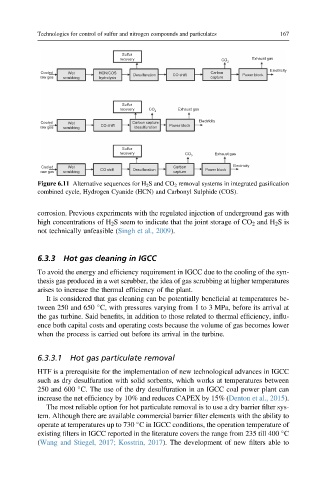
           Figure 6.11 Alternative sequences for H 2 S and CO 2 removal systems in integrated gasification
           combined cycle, Hydrogen Cyanide (HCN) and Carbonyl Sulphide (COS).


           corrosion. Previous experiments with the regulated injection of underground gas with
           high concentrations of H 2 S seem to indicate that the joint storage of CO 2 and H 2 Sis
           not technically unfeasible (Singh et al., 2009).


           6.3.3  Hot gas cleaning in IGCC

           To avoid the energy and efficiency requirement in IGCC due to the cooling of the syn-
           thesis gas produced in a wet scrubber, the idea of gas scrubbing at higher temperatures
           arises to increase the thermal efficiency of the plant.
              It is considered that gas cleaning can be potentially beneficial at temperatures be-
           tween 250 and 650 C, with pressures varying from 1 to 3 MPa, before its arrival at

           the gas turbine. Said benefits, in addition to those related to thermal efficiency, influ-
           ence both capital costs and operating costs because the volume of gas becomes lower
           when the process is carried out before its arrival in the turbine.


           6.3.3.1  Hot gas particulate removal
           HTF is a prerequisite for the implementation of new technological advances in IGCC
           such as dry desulfuration with solid sorbents, which works at temperatures between
           250 and 600 C. The use of the dry desulfuration in an IGCC coal power plant can

           increase the net efficiency by 10% and reduces CAPEX by 15% (Denton et al., 2015).
              The most reliable option for hot particulate removal is to use a dry barrier filter sys-
           tem. Although there are available commercial barrier filter elements with the ability to

           operate at temperatures up to 730 C in IGCC conditions, the operation temperature of

           existing filters in IGCC reported in the literature covers the range from 235 till 400 C
           (Wang and Stiegel, 2017; Kosstrin, 2017). The development of new filters able to

