


Page 125 - Optical Switching And Networking Handbook
P. 125
06_200023_CH05/Batesx  1/17/01 8:19 AM  Page 110


                    110                                                                      Chapter 5


                                     cations channels. Yet the industry began to recognize the changes in
                                     consumption patterns.The demand for multimedia communications,
                                     video, and  wide-area networks (WANs) started to erode even the
                                     highest capacities available.
                                        To solve this problem, researchers began to experiment with the
                                     use of more than one light beam on the same cable. Light operates in
                                     the frequency spectrum similar to the older cable  TV systems
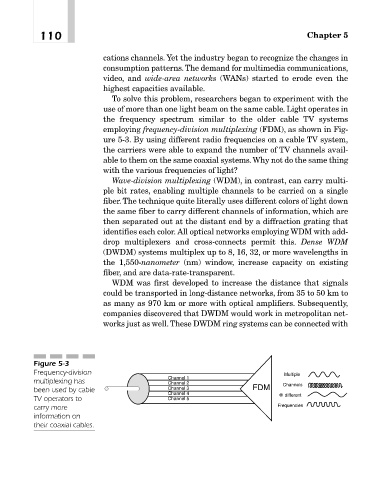
                                     employing frequency-division multiplexing (FDM), as shown in Fig-
                                     ure 5-3. By using different radio frequencies on a cable TV system,
                                     the carriers were able to expand the number of TV channels avail-
                                     able to them on the same coaxial systems.Why not do the same thing
                                     with the various frequencies of light?
                                        Wave-division multiplexing (WDM), in contrast, can carry multi-
                                     ple bit rates, enabling multiple channels to be carried on a single
                                     fiber. The technique quite literally uses different colors of light down
                                     the same fiber to carry different channels of information, which are
                                     then separated out at the distant end by a diffraction grating that
                                     identifies each color. All optical networks employing WDM with add-
                                     drop multiplexers and cross-connects permit this. Dense WDM
                                     (DWDM) systems multiplex up to 8, 16, 32, or more wavelengths in
                                     the 1,550-nanometer (nm) window, increase capacity on existing
                                     fiber, and are data-rate-transparent.
                                        WDM was first developed to increase the distance that signals
                                     could be transported in long-distance networks, from 35 to 50 km to
                                     as many as 970 km or more with optical amplifiers. Subsequently,
                                     companies discovered that DWDM would work in metropolitan net-
                                     works just as well.These DWDM ring systems can be connected with


                  Figure 5-3
                  Frequency-division                                                   Multiple
                                                       Channel 1
                  multiplexing has                     Channel 2                      Channels
                  been used by cable                   Channel 3              FDM
                                                       Channel 4                     @ different
                  TV operators to                      Channel 5
                  carry more                                                         Frequencies
                  information on
                  their coaxial cables.

