


Page 113 - Partition & Adsorption of Organic Contaminants in Environmental Systems
P. 113
104   ADSORPTION OF VAPORS ON MINERALS AND OTHER SOLIDS

                     600
                             Activated carbon-water
                             Activiated carbon-benzene
                    Vapor Uptake, Q (mg/g)  400


                     200


                       0
                        0        0.2      0.4       0.6      0.8      1.0
                                       Relative Pressure, P/P°
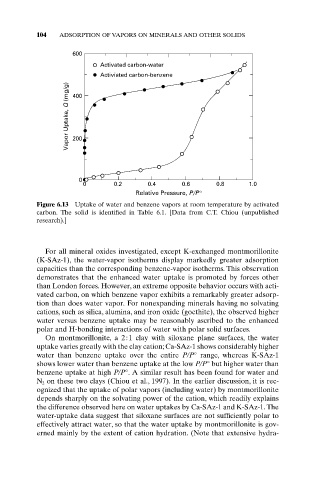
           Figure 6.13 Uptake of water and benzene vapors at room temperature by activated
           carbon. The solid is identified in  Table 6.1. [Data from C.T. Chiou (unpublished
           research).]


              For all mineral oxides investigated, except K-exchanged montmorillonite
           (K-SAz-1), the water-vapor isotherms display markedly greater adsorption
           capacities than the corresponding benzene-vapor isotherms. This observation
           demonstrates that the enhanced water uptake is promoted by forces other
           than London forces. However, an extreme opposite behavior occurs with acti-
           vated carbon, on which benzene vapor exhibits a remarkably greater adsorp-
           tion than does water vapor. For nonexpanding minerals having no solvating
           cations, such as silica, alumina, and iron oxide (goethite), the observed higher
           water versus benzene uptake may be reasonably ascribed to the enhanced
           polar and H-bonding interactions of water with polar solid surfaces.
              On montmorillonite, a 2:1 clay with siloxane plane surfaces, the water
           uptake varies greatly with the clay cation; Ca-SAz-1 shows considerably higher
           water than benzene uptake over the entire  P/P° range, whereas K-SAz-1
           shows lower water than benzene uptake at the low P/P° but higher water than
           benzene uptake at high P/P°. A similar result has been found for water and
           N 2 on these two clays (Chiou et al., 1997). In the earlier discussion, it is rec-
           ognized that the uptake of polar vapors (including water) by montmorillonite
           depends sharply on the solvating power of the cation, which readily explains
           the difference observed here on water uptakes by Ca-SAz-1 and K-SAz-1. The
           water-uptake data suggest that siloxane surfaces are not sufficiently polar to
           effectively attract water, so that the water uptake by montmorillonite is gov-
           erned mainly by the extent of cation hydration. (Note that extensive hydra-

