


Page 150 - Petroleum and Gas Field Processing
P. 150
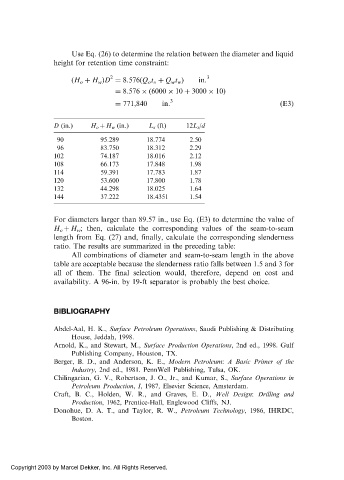
Use Eq. (26) to determine the relation between the diameter and liquid
            height for retention time constraint:

                           2                         3
                 ðH o þ H w ÞD ¼ 8:576ðQ o t o þ Q w t w Þ  in:
                            ¼ 8:576  ð6000   10 þ 3000   10Þ
                            ¼ 771,840    in: 3                           ðE3Þ


            D (in.)   H o þ H w (in.)  L s (ft)  12L s /d
             90         95.289       18.774     2.50
             96         83.750       18.312     2.29
            102         74.187       18.016     2.12
            108         66.173       17.848     1.98
            114         59.391       17.783     1.87
            120         53.600       17.800     1.78
            132         44.298       18.025     1.64
            144         37.222       18.4351    1.54

            For diameters larger than 89.57 in., use Eq. (E3) to determine the value of
            H o þ H w ; then, calculate the corresponding values of the seam-to-seam
            length from Eq. (27) and, finally, calculate the corresponding slenderness
            ratio. The results are summarized in the preceding table:
                 All combinations of diameter and seam-to-seam length in the above
            table are acceptable because the slenderness ratio falls between 1.5 and 3 for
            all of them. The final selection would, therefore, depend on cost and
            availability. A 96-in. by 19-ft separator is probably the best choice.


            BIBLIOGRAPHY

            Abdel-Aal, H. K., Surface Petroleum Operations, Saudi Publishing & Distributing
                 House, Jeddah, 1998.
            Arnold, K., and Stewart, M., Surface Production Operations, 2nd ed., 1998. Gulf
                 Publishing Company, Houston, TX.
            Berger, B. D., and Anderson, K. E., Modern Petroleum: A Basic Primer of the
                 Industry, 2nd ed., 1981. PennWell Publishing, Tulsa, OK.
            Chilingarian, G. V., Robertson, J. O., Jr., and Kumar, S., Surface Operations in
                 Petroleum Production, I, 1987, Elsevier Science, Amsterdam.
            Craft, B. C., Holden, W. R., and Graves, E. D., Well Design: Drilling and
                 Production, 1962, Prentice-Hall, Englewood Cliffs, NJ.
            Donohue, D. A. T., and Taylor, R. W., Petroleum Technology, 1986, IHRDC,
                 Boston.


 Copyright 2003 by Marcel Dekker, Inc. All Rights Reserved.

