


Page 469 - Petrophysics
P. 469
RADIAL FLOW SYSTEMS           437


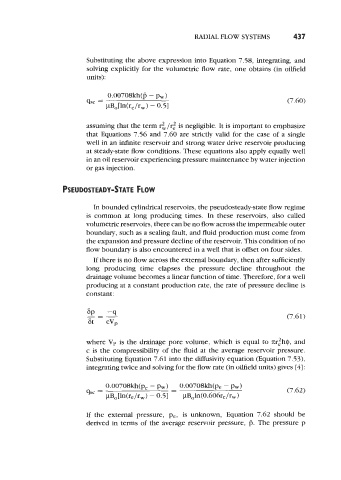
                           Substituting the above expression into Equation 7.58, integrating, and
                           solving explicitly for the volumetric flow rate, one obtains (in oilfield
                           units):


                                                                                        (7.60)


                           assuming that the term </rz  is negligible. It is important to emphasize
                           that  Equations 7.56 and 7.60 are strictly valid for the case of  a single
                           well in an infinite reservoir and strong water drive reservoir producing
                           at steady-state flow conditions. These equations also apply equally well
                           in an oil reservoir experiencing pressure maintenance by water injection
                           or gas injection.


                    PSEUDOSTEADY-STATE
                                           FLOW

                              In bounded cylindrical reservoirs, the pseudosteady-state flow regime
                           is  common  at  long producing times.  In  these  reservoirs,  also  called
                           volumetric reservoirs, there can be no flow across the impermeable outer
                           boundary, such as a sealing fault, and fluid production must come from
                           the expansion and pressure decline of the reservoir. This condition of no
                           flow boundary is also encountered in a well that is offset on four sides.
                              If there is no flow across the external boundary, then after sufficiently
                           long  producing  time  elapses  the  pressure  decline  throughout  the
                           drainage volume becomes a linear function of time. Therefore, for a well
                           producing at a constant production rate, the rate of  pressure decline is
                           constant:


                                                                                        (7.61)


                           where Vp  is the drainage pore volume, which is equal to nrzh@, and
                           c is the compressibility of  the fluid at the average reservoir pressure.
                           Substituting Equation 7.61 into the diffusivity equation (Equation 7.53,
                           integrating twice and solving for the flow rate (in oiLfield units) gives [4] :


                                                                                        (7.62)


                           If  the  external pressure,  pe,  is  unknown,  Equation  7.62  should  be
                           derived in terms of  the average reservoir pressure, p. The pressure p

