


Page 470 - Petrophysics
P. 470
438    PETROPHYSICS: RESERVOIR ROCK PROPERTIES


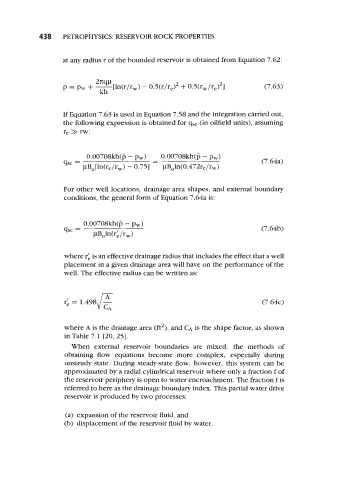
                    at any radius r of the bounded reservoir is obtained from Equation 7.62:


                              2w-l
                    p=pw+-         [W/rw> - O.5(r/r,l2 + 0.5(rw/r,)2]            (7.63)
                               kh


                    If Equation 7.63 is used in Equation 7.58 and the integration carried out,
                    the following expression is obtained for qsc (in oilfield units), assuming
                    re >>  TW:


                           O.O0708kh(P - pw)      O.O0708kh(P - pw)
                                               -
                    qsc =                      -                                (7.64a)
                          pBo[ln(r.Jrw)  - 0.751   pB,ln(0.472re/rw)

                    For other well locations, drainage area shapes, and external boundary
                    conditions, the general form of Equation 7.64a is:


                                                                                (7.64b)


                    where T', is an effective drainage radius that includes the effect that a well
                    placement in a given drainage area will have on the performance of the
                    well. The effective radius can be written as:


                                                                                (7.64~)


                    where A is the drainage area (ft2), and CA is the shape factor, as shown
                    in Table 7.1 [20, 251.
                      When  external  reservoir  boundaries  are  mixed,  the  methods  of
                    obtaining  flow  equations  become  more  complex,  especially  during
                    unsteady state. During steady-state flow, however, this system can be
                    approximated by a radial cylindrical reservoir where only a fraction f of
                    the reservoir periphery is open to water encroachment. The fraction f is
                    referred to here as the drainage boundary index. This partial water drive
                    reservoir is produced by two processes:


                     (a)  expansion of the reservoir fluid, and
                    (b)  displacement of the reservoir fluid by water.

