


Page 563 - Petrophysics
P. 563
530    PETROPHYSICS: RESERVOIR ROCK PROPERTIES


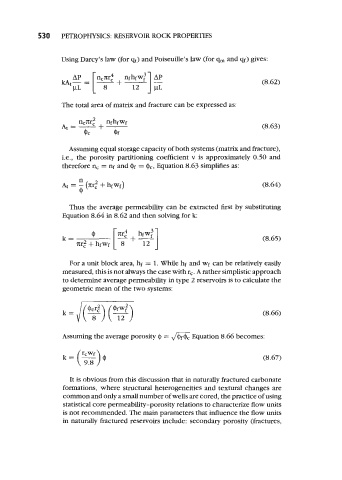
                    Using Darcy's law (for qt) and Poiseuille's law (for % and sf) gives:


                                                                                 (8.62)


                    The total area of matrix and fracture can be expressed as:


                                                                                 (8.63)


                      Assuming equal storage capacity of both systems (matrix and fracture),
                    i.e.,  the porosity partitioning coefficient v  is approximately 0.50 and
                    therefore n, = nf and @f = Qc, Equation 8.63 simplifies as:

                    At  =  (nr:  + hfwf)                                         (8.64)


                      Thus the average permeability can be extracted first by substituting
                    Equation 8.64 in 8.62 and then solving for k:


                                                                                 (8.65)


                      For a unit block area, hf = 1. While hf and wf can be relatively easily
                    measured,  this is not always the case with rc. A rather simplistic approach
                    to determine average permeability in type 2 reservoirs is to calculate the
                    geometric mean of the two systems:


                                                                                 (8.66)


                    Assuming the average porosity @ =      Equation 8.66 becomes:


                      It is obvious from this discussion that in naturally fractured carbonate
                    formations, where structural heterogeneities and textural changes are
                    common and only a small number of wells are cored, the practice of using
                    statistical core permeability-porosity relations  to characterize flow units
                    is not recommended. The main parameters that influence the flow units
                    in naturally fractured reservoirs include: secondary porosity (fractures,

