


Page 564 - Petrophysics
P. 564
FLUID FLOW MODELING IN FRACTURES              53 1


                        fissures, and vugs),  matrix porosity, fracture intensity index, fracture
                        dimensions (shape, width, and height), tortuosity, porosity, partitioning
                        coefficient, specific surface area, and irreducible water saturation. These
                        parameters must be incorporated in the definition of flow units in order
                        to effectively characterize them.


                 FLUID FLOW MODELING FRACTURES
                                              IN

                          Fractures are modeled as flow channels or cracks. Their two main
                        properties from the fluid flow point of  view are the storage capacity
                        and the fluid transmission or transfer capacity, also known as fracture
                        conductivity. These two properties are dependent on the dimensions of
                        length, width, and height.

                 FRACTURE AREA


                          Fracture area is determined by the shape and relative dimension of
                        the fracture, and influences the mechanical behavior of the rock mass.
                        Fractures are usually assumed to be circularly shaped, with constant
                        radius, or parallelogram shaped, using a rectangle or square shape as
                        a simplifying assumption. Fracture area is influenced by the extent of
                        the fracture. There are three cases: (1) fractures are infinitely laterally
                        extensive, (2)  fractures terminate on other fractures, and (3) fractures
                        terminate in intact rock. However, from fluid transfer point of view they
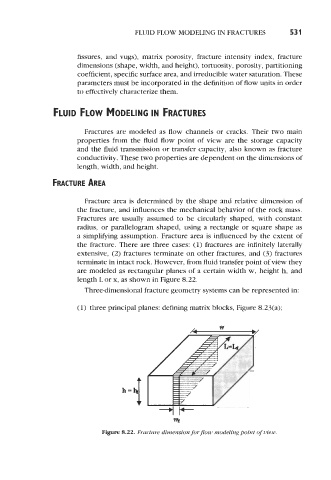
                        are modeled as rectangular planes of a certain width w, height h, and
                        length L or x, as shown in Figure 8.22.
                          Three-dimensional fracture geometry systems can be represented in:

                        (1) three principal planes: defining matrix blocks, Figure 8.23(a);


                                                     Hk
                               Figure 8.22. Fracture dimension for flow modeling point of view.

