


Page 315 - Physical chemistry understanding our chemical world
P. 315
282    ELECTROCHEMISTRY


                       What is the simplest way to clean a tarnished silver
                       spoon?

                      Electrochemistry: the chemistry of electron transfer

                                      Cutlery or ornaments made of silver tarnish and become black;
              Oxidation is loss of    this is a shame, because clean, shiny silver is very attractive. The
              electrons. Reduction is  ‘tarnish’ comprises a thin layer of silver that has oxidized following
              gain of electrons.
                                      contact with the air to form black silver(I) oxide:

              In fact, the tarnish on                 4Ag (s)  + O 2(g) −−→ 2Ag O (s)       (7.5)
                                                                            2
              silver usually comprises
              both silver(I) oxide      Such silver can be rather difficult to clean without abrasives
              and a little silver(I)  (which wear away the metal). The following is a simple electro-
              sulphide.
                                      chemical means of cleaning the silver: immerse the tarnished silver
                                      in a saucer of electrolyte, such as salt solution or vinegar, and wrap
                      it in a piece of aluminium foil. Within a few minutes the silver is cleaner and bright,
                      whereas the aluminium has lost some of its shininess.
                        The shine from the aluminium is lost as atoms on the surface of the foil are
                      oxidized to form Al 3+  ions (Equation (7.1)), which diffuse into solution. Because
                      the aluminium touches the silver, the electrons generated by Equation (7.1) enter the
                      silver and cause electro-reduction of the surface layer of Ag O (Equation (7.2)).
                                                                           2
                        In summary, we construct a simple electrochemical cell in which the silver to be
                      cleaned is the cathode (Equation (7.2)) and aluminium foil as the anode supplies the
                      electrons via Equation (7.1).
                        The salt or vinegar acts as an electrolyte, and is needed since the product Al 3+
                      requires counter ions to ensure electro-neutrality (so aluminium ethanoate forms).
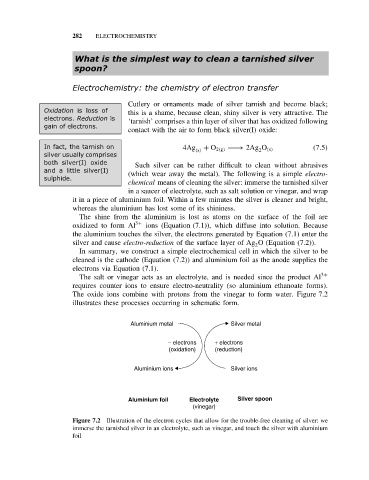
                      The oxide ions combine with protons from the vinegar to form water. Figure 7.2
                      illustrates these processes occurring in schematic form.


                                       Aluminium metal              Silver metal


                                                  − electrons  + electrons
                                                  (oxidation)  (reduction)

                                        Aluminium ions              Silver ions


                                      Aluminium foil    Electrolyte   Silver spoon
                                                         (vinegar)

                      Figure 7.2 Illustration of the electron cycles that allow for the trouble-free cleaning of silver: we
                      immerse the tarnished silver in an electrolyte, such as vinegar, and touch the silver with aluminium
                      foil

