


Page 317 - Physical chemistry understanding our chemical world
P. 317
284    ELECTROCHEMISTRY

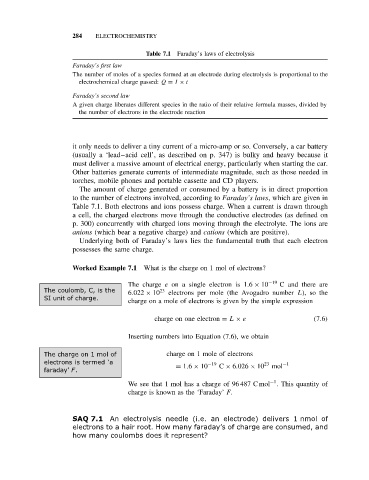
                                           Table 7.1 Faraday’s laws of electrolysis
                      Faraday’s first law
                      The number of moles of a species formed at an electrode during electrolysis is proportional to the
                        electrochemical charge passed: Q = I × t

                      Faraday’s second law
                      A given charge liberates different species in the ratio of their relative formula masses, divided by
                        the number of electrons in the electrode reaction


                      it only needs to deliver a tiny current of a micro-amp or so. Conversely, a car battery
                      (usually a ‘lead–acid cell’, as described on p. 347) is bulky and heavy because it
                      must deliver a massive amount of electrical energy, particularly when starting the car.
                      Other batteries generate currents of intermediate magnitude, such as those needed in
                      torches, mobile phones and portable cassette and CD players.
                        The amount of charge generated or consumed by a battery is in direct proportion
                      to the number of electrons involved, according to Faraday’s laws, which are given in
                      Table 7.1. Both electrons and ions possess charge. When a current is drawn through
                      a cell, the charged electrons move through the conductive electrodes (as defined on
                      p. 300) concurrently with charged ions moving through the electrolyte. The ions are
                      anions (which bear a negative charge) and cations (which are positive).
                        Underlying both of Faraday’s laws lies the fundamental truth that each electron
                      possesses the same charge.

                      Worked Example 7.1 What is the charge on 1 mol of electrons?

                                      The charge e on a single electron is 1.6 × 10 −19  Cand there are
              The coulomb, C, is the           23
                                      6.022 × 10  electrons per mole (the Avogadro number L), so the
              SI unit of charge.
                                      charge on a mole of electrons is given by the simple expression
                                              charge on one electron = L × e                (7.6)

                                      Inserting numbers into Equation (7.6), we obtain


              Thechargeon1 molof                 charge on 1 mole of electrons
              electrons is termed ‘a                = 1.6 × 10 −19  C × 6.026 × 10 23  mol −1
              faraday’ F.
                                                                               −1
                                      We see that 1 mol has a charge of 96 487 C mol . This quantity of
                                      charge is known as the ‘Faraday’ F.


                      SAQ 7.1 An electrolysis needle (i.e. an electrode) delivers 1 nmol of
                      electrons to a hair root. How many faraday’s of charge are consumed, and
                      how many coulombs does it represent?

