


Page 322 - Physical chemistry understanding our chemical world
P. 322
INTRODUCTION TO CELLS: TERMINOLOGY AND BACKGROUND        289


              Why do hydrogen fuel cells sometimes ‘dry up’?

             Cells and half-cells

             Hydrogen fuel cells promise to fuel prototype cars in the near future. We define such
             a fuel cell as a machine for utilizing the energies of hydrogen and oxygen gases,
             hitherto separated, to yield a usable electric current without combustion or explosion.
             Unlike the simple batteries above, the oxygen and hydrogen gases fuelling these cells
             are transported from large, high-pressure tanks outside the cell. The gases then feed
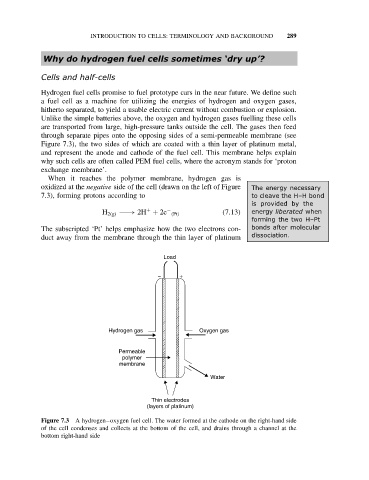
             through separate pipes onto the opposing sides of a semi-permeable membrane (see
             Figure 7.3), the two sides of which are coated with a thin layer of platinum metal,
             and represent the anode and cathode of the fuel cell. This membrane helps explain
             why such cells are often called PEM fuel cells, where the acronym stands for ‘proton
             exchange membrane’.
               When it reaches the polymer membrane, hydrogen gas is
             oxidized at the negative side of the cell (drawn on the left of Figure  The energy necessary
             7.3), forming protons according to                           to cleave the H–H bond
                                                                          is provided by the
                                            +    −                        energy liberated when
                               H 2(g) −−→ 2H + 2e (Pt)            (7.13)
                                                                          forming the two H–Pt
             The subscripted ‘Pt’ helps emphasize how the two electrons con-  bonds after molecular
             duct away from the membrane through the thin layer of platinum  dissociation.


                                                 Load

                                               −     +


                                 Hydrogen gas              Oxygen gas

                                   Permeable
                                    polymer
                                    membrane
                                                              Water


                                             Thin electrodes
                                            (layers of platinum)

             Figure 7.3 A hydrogen–oxygen fuel cell. The water formed at the cathode on the right-hand side
             of the cell condenses and collects at the bottom of the cell, and drains through a channel at the
             bottom right-hand side

