


Page 404 - Pipeline Risk Management Manual Ideas, Techniques, and Resources
P. 404
.
                                                                                      Appendix G1379


                                                    Appendix G
                                                     Examples of

                                                     Common Pipeline

                                                     Inspection and
                                                     Survey Techniques


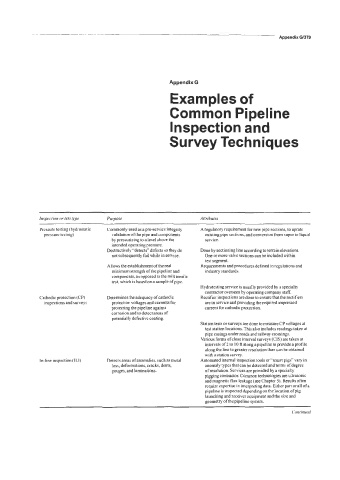
             Inspection or test ppe   Purpose                 Attributes
             Pressure testing (hydrostatic   Commonly used as a pre-service integrity   A regulatory requirement for new pipe sections, to uprate
              pressure testing)    validation ofthe pipe and components   existing pipe sections. and conversion from vapor to liquid
                                   by pressurizing to a level above the   service.
                                   intended operating pressure.
                                  Destructively “detects” defects so they do   Done by sectioning line according to terrain elevations.
                                   not subsequently fail while in service.   One or more valve sections can be included within
                                                               test segment.
                                  Allows the establishment ofthe real   Requirements and procedures defined in regulations and
                                   minimum strength ofthe pipeline and   industry standards.
                                   components, as opposed to the mill tensile
                                   test, which is based on a sample ofpipe.
                                                              Hydrotesting service is usually provided by a specialty
                                                               contractor overseen by operating company staff.
             Cathodic protection (CP)   Determines the adequacy of cathodic   Rectifier inspections are done to ensure that the rectifiers
               inspections and surveys   protection voltages and currents for   are in service and providing the required impressed
                                   protecting the pipeline against   current for cathodic protection.
                                   corrosion and to detect areas of
                                   potentially defective coating.
                                                              Station tests or surveys are done to measure CP voltages at
                                                               test station locations. This also includes readings taken at
                                                               pipe casings under roads and railway crossings.
                                                              Various forms ofclose interval surveys (CIS) are taken at
                                                               intervals of 2 to IO ft along a pipeline to provide a profile
                                                               along the line to greater resolution than can be obtained
                                                               with a station survey.
             In-line inspection (ILI)   Detects areas of anomalies, such as metal   Automated internal inspection tools or “smart pigs” vary in
                                   loss, deformations, cracks, dents,   anomaly types that can be detected and terms of degree
                                   gouges, and laminations.    ofresolution. Services are provided by a specialty
                                                               pigging contractor. Common technologles are ultrasonic
                                                               and magnetic flux leakage (see Chapter 5). Results often
                                                               require expertise in interpreting data. Either part or all of a
                                                               pipeline is inspected depending on the location of pig
                                                                launching and receiver equipment and the size and
                                                                geometry of the pipeline system.
                                                                                          Continued

