


Page 405 - Pipeline Risk Management Manual Ideas, Techniques, and Resources
P. 405
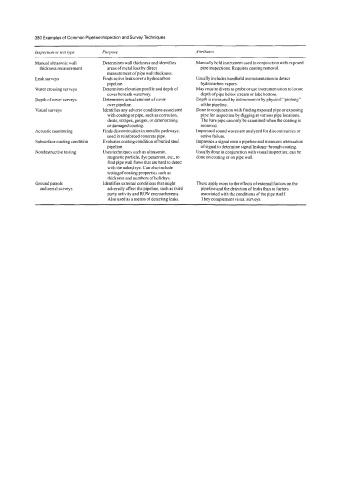
380 Examples of Common Pipeline Inspection and Survey Techniques
            Inspection or test type   Purpose               Attributes

            Manual ultrasonic wall   Determines wall thickness and identifies   Manually held instrument used in conjunction with exposed
             thickness measurement   areas of metal loss by direct   pipe inspections. Requires coating removal.
                                  measurement ofpipe wall thickness.
            Leak surveys        Finds active leaks over a hydrocarbon   Usually includes handheld instrumentation to detect
                                  pipeline.                   hydrocarbon vapors.
            Water crossing surveys   Determines elevation profile and depth of   May require divers to probe or use instrumentation to locate
                                  cover beneath waterway.     depth ofpipe below stream or lake bottom.
            Depth of cover surveys   Determines actual amount of cover   Depth is measured by instrument or by physical “probing”
                                  over pipeline.              ofthe pipeline.
            Visual surveys      Identifies any adverse conditions associated   Done in conjunction with finding exposed pipe or exposing
                                  with coating or pipe, such as corrosion,   pipe for inspection by digging at various pipe locations.
                                  dents, scrapes, gouges, or deteriorating   The hare pipe can only be examined when the coating is
                                  or damaged coating.         removed.
            Acoustic monitoring   Finds discontinuities in metallic pathways;   Impressed sound waves are analyzed for discontinuities or
                                  used in reinforced concrete pipe.   active failure.
            Subsurface coating condition   Evaluates coating condition of buried steel   Impresses a signal onto a pipeline and measures attenuation
                                  pipeline.                   of signal to determine signal leakage through coating.
            Nondestructive testing   Uses techniques such as ultrasonic,   Usually done in conjunction with visual inspection; can he
                                  magnetic particle, dye penetrant, etc., to   done on coating or on pipe wall.
                                  find pipe wall flaws that are hard to detect
                                  with the naked eye. Can also include
                                  testingof coating properties such as
                                  thickness and numbers of holidays.
            Ground patrols      Identifies external conditions that might   These apply more to the effects  of external factors on the
             and aerial surveys   adversely affect the pipeline, such as third   pipeline and the detection of leaks than to factors
                                  party activity and ROW encroachments.   associated with the conditions ofthe pipe itself.
                                  Also used as a means of detecting leaks.   They complement visual surveys.

