


Page 262 - Pipelines and Risers
P. 262
Remaining Strength of Corroded Pipes                                  235


        Effect of Corrosion Width
        Figure 14.4 shows the effect of defect width on burst pressure with a longitudinal defect (Mok
        et al. (1991)), for the case of  X52, OD=508mm, t=6.35mm,  dltS.4. It can be concluded in
        Mok’s  studies that the  width  effect is negligible on  the  burst  pressure of  pipe  with  long
        longitudinal defects.

        Irregular Shaped Corrosion
        The major weakness of  the existing B31G criterion is its over-conservative estimation of  the
        corroded area for long and irregular shaped corrosion (Bai et al. (1994), Kiefner and Vieth
        (1990), Hopkins and Jones (1992)). Therefore, the key to the irregularly shaped corrosion is
        the accurate estimation of the corroded area.

        Two shapes were considered in the development of the original B31G criterion. One was the
        rectangle area method. The other was the parabola area method. Tests of Hopkins and Jones
        (1992) indicated that irregularly shaped corrosion could be conservative assessed using the
        B31G criteria when the accurate cross-sectional area of the corrosion defect was used.


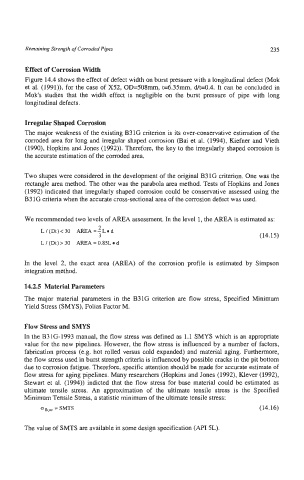
        We recommended two levels of AREA assessment. In the level 1, the AREA is estimated as:
                             2
             L I (Dt)< 30  AREA =-L* d
                             3                                             (14.15)
             L /(Dt)> 30  AREA = 0.85L. d

        In  the  level  2,  the  exact  area  (AREA) of  the  corrosion profile is  estimated by  Simpson
        integration method.

        14.2.5  Material Parameters
        The major material  parameters in  the B31G  criterion are flow  stress, Specified Minimum
        Yield Stress (SMYS), Folias Factor M.

        Flow Stress and SMYS
        In the B31G-1993 manual, the flow stress was defined as 1.1 SMYS which is an appropriate
        value for the new pipelines. However, the flow stress is influenced by a number of  factors,
        fabrication process (e.g. hot rolled versus cold expanded) and material aging. Furthermore,
        the flow stress used in burst strength criteria is influenced by possible cracks in the pit bottom
        due to corrosion fatigue. Therefore, specific attention should be made for accurate estimate of
        flow stress for aging pipelines. Many researchers (Hopkins and Jones (1992), Klever (1992),
        Stewart et al. (1994)) indicted that the flow stress for base material could be estimated as
        ultimate  tensile  stress.  An  approximation  of  the  ultimate  tensile  stress  is  the  Specified
        Minimum Tensile Stress, a statistic minimum of the ultimate tensile stress:
             oflow = SMTS                                                  (14.16)

        The value of SMTS are available in some design specification (API 5L).

