


Page 414 - Planning and Design of Airports
P. 414
Airport Drainage    359


                       t  =  time water flows in pipe
                        d
                       σ =  rate of supply, or rainfall in excess of rate of infiltration,
                          in/h
                       L = effective length of overland or channel flow, ft
                       n = retardance coefficient
                    The term t  is nothing more than the time of concentration for the
                             c
                 drainage area under consideration. The term L, the effective length,
                 represents the length of overland sheet flow from the most remote
                 point in the drainage area to the drain inlet, measured in a direction
                 parallel to the maximum slope, before the runoff has reached a defined
                 channel or ponding basin, plus the length of flow in a channel if one is
                 present. If ponding is permitted, L is measured from the most remote
                 point in the drainage area to the mean edge of the pond.
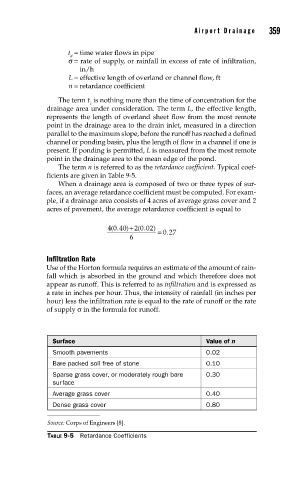
                    The term n is referred to as the retardance coefficient. Typical coef-
                 ficients are given in Table 9-5.
                    When a drainage area is composed of two or three types of sur-
                 faces, an average retardance coefficient must be computed. For exam-
                 ple, if a drainage area consists of 4 acres of average grass cover and 2
                 acres of pavement, the average retardance coefficient is equal to

                                  4 0 40)+  2 0 02)  =  027
                                   (.
                                          (.
                                                  .
                                        6
                 Infiltration Rate
                 Use of the Horton formula requires an estimate of the amount of rain-
                 fall which is absorbed in the ground and which therefore does not
                 appear as runoff. This is referred to as infiltration and is expressed as
                 a rate in inches per hour. Thus, the intensity of rainfall (in inches per
                 hour) less the infiltration rate is equal to the rate of runoff or the rate
                 of supply σ in the formula for runoff.


                   Surface                                   Value of n
                   Smooth pavements                          0.02
                   Bare packed soil free of stone            0.10
                   Sparse grass cover, or moderately rough bare   0.30
                   surface
                   Average grass cover                       0.40
                   Dense grass cover                         0.80

                 Source: Corps of Engineers [8].
                 TABLE 9-5  Retardance Coefficients

