


Page 436 - Planning and Design of Airports
P. 436
376    Airp o r t  D e sign


                                                             n
             Pipe
               Clay and concrete
                 Good alignment, smooth joints, smooth transitions  0.013
                 Less favorable flow conditions              0.015
              Corrugated metal
                 100% of periphery smoothly lined            0.013
                 Paved invert, 50% of periphery paved        0.018
                 Paved invert, 25% of periphery paved        0.021
                 Unpaved, bituminous-coated or noncoated     0.024
             Open channels
              Paved                                          0.015–0.020
              Unpaved
                 Bare earth, shallow flow                    0.020–0.025
                 Bare earth, depth of flow over 1 ft         0.015–0.020
               Turf, shallow flow                            0.06–0.08
                 Turf, depth of flow over 1 ft               0.04–0.06

            Source: Federal Aviation Administration [2].
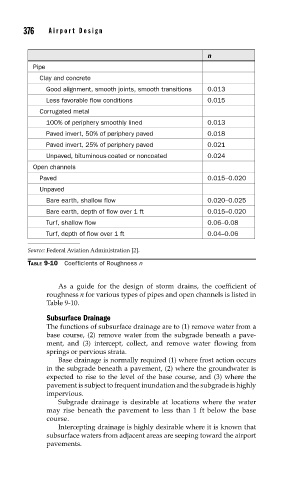
            TABLE 9-10  Coefficients of Roughness n


                    As a guide for the design of storm drains, the coefficient of
                 roughness n for various types of pipes and open channels is listed in
                 Table 9-10.
                 Subsurface Drainage
                 The functions of subsurface drainage are to (1) remove water from a
                 base course, (2) remove water from the subgrade beneath a pave-
                 ment, and (3) intercept, collect, and remove water flowing from
                 springs or pervious strata.
                    Base drainage is normally required (1) where frost action occurs
                 in the subgrade beneath a pavement, (2) where the groundwater is
                 expected to rise to the level of the base course, and (3) where the
                 pavement is subject to frequent inundation and the subgrade is highly
                 impervious.
                    Subgrade drainage is desirable at locations where the water
                 may rise beneath the pavement to less than 1 ft below the base
                 course.
                    Intercepting drainage is highly desirable where it is known that
                 subsurface waters from adjacent areas are seeping toward the airport
                 pavements.

