


Page 651 - Polymer-based Nanocomposites for Energy and Environmental Applications
P. 651
Recent advances in polyaniline-based nanocomposites as potential adsorbents for trace metal ions  601

           incorporated ligand. These chelating groups provide a negative residual charge to the
           surface of composites. Thus, depending on the solution pH, the surface atoms hold a
           lone pair of electron responsible for interaction with metal ions. Compared with other
           adsorbents, the utilization of polyaniline nanocomposites may offer several advan-
           tages. First, organic polymeric part of the composite provides mechanical and chem-
           ical stability, whereas the inorganic structure part supports the metal ion complexation
           regarding its selectivity for some particular metal ions and thermal stability and also
           increases the electric conductivity. In addition to these characteristics, the hybrid
           nanomaterials were considered as new composite materials that exhibit very different
           properties from their original components, that is, organic polymer and inorganic
           materials especially in the case of molecular level hybrids. Thus, the synthesis of poly-
           aniline nanocomposites has received a great deal of attention because it provided new
           materials with special mechanical, chemical, electrochemical, and optical as well as
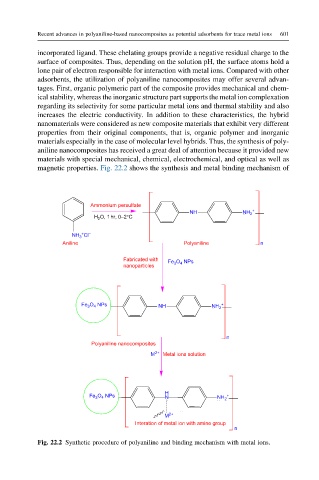
           magnetic properties. Fig. 22.2 shows the synthesis and metal binding mechanism of


                         Ammonium persulfate
                                                    NH             NH 2 +
                          H 2 O, 1 hr, 0−2°C
                       +  −
                    NH 3 Cl
                  Aniline                          Polyaniline         n

                                  Fabricated with   Fe 3 O 4  NPs
                                  nanoparticles


                       Fe 3 O 4  NPs        NH            NH 2 +


                                                              n
                          Polyaniline nanocomposites
                                          M 2+  Metal ions solution


                                              H
                         Fe 3 O 4  NPs        N             NH 2 +

                                             M 2+
                                      Interation of metal ion with amine group
                                                                n
           Fig. 22.2 Synthetic procedure of polyaniline and binding mechanism with metal ions.

