


Page 362 - Practical Ship Design
P. 362
Freeboard and Subdivision                                            319

                 1 .o

         R      0.8                                          R = (0 002 + 0 0009 LS)’”
         Required
        subdivision
         index   0.6


                0.4

                0.2

                  0
                    0        100       200       300       400
                                      Ls in metres
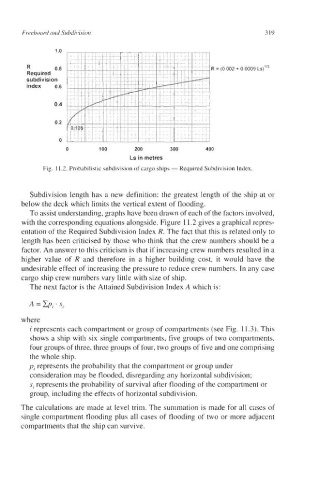
             Fig. 11.2. Probabilistic subdivision of cargo ships - Required Subdivision Index.


         Subdivision length has a new definition: the greatest length of the ship at or
       below the deck which limits the vertical extent of flooding.
         To assist understanding, graphs have been drawn of each of the factors involved,
       with the corresponding equations alongside. Figure 1 1.2 gives a graphical repres-
       entation of the Required Subdivision Index R. The fact that this is related only to
       length has been criticised by those who think that the crew numbers should be a
       factor. An answer to this criticism is that if increasing crew numbers resulted in a
       higher  value  of  R  and  therefore  in  a  higher  building  cost,  it  would  have  the
       undesirable effect of increasing the pressure to reduce crew numbers. In any case
       cargo ship crew numbers vary little with size of ship.
         The next factor is the Attained Subdivision Index A which is:


       where
          i represents each compartment or group of compartments (see Fig. 11.3). This
          shows a ship with six single compartments, five groups of two compartments,
          four groups of three, three groups of four, two groups of five and one comprising
          the whole ship.
         pi represents the probability that the compartment or group under
          consideration may be flooded, disregarding any horizontal subdivision;
         si represents the probability of survival after flooding of the compartment or
          group, including the effects of horizontal subdivision.

       The calculations are made at level trim. The summation is made for all cases of
       single compartment flooding plus all cases of flooding of two or more adjacent
       compartments that the ship can survive.

