


Page 177 - Principles and Applications of NanoMEMS Physics
P. 177
4. NANOMEMS APPLICATIONS: CIRCUITS AND SYSTEMS                165


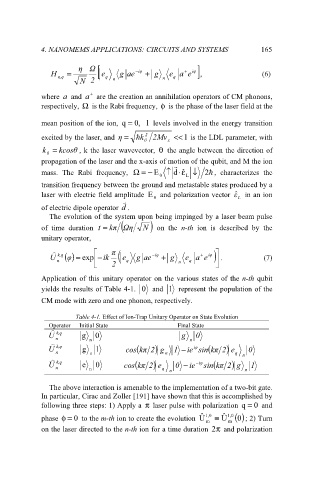
               H    =  Ș  ȍ  [e    g  ae − iij  +  g  e  a + e iij  ],                                (6)
                 n, q          q  n            n  q
                        N  2
                           +
             where  a  and  a  are the creation an annihilation operators of CM phonons,
             respectively, Ω  is the Rabi frequency,  φ  is the phase of the laser field at the

             mean position of the ion,  q =  , 0  1 levels involved in the energy transition

             excited by the laser, and  =Ș  k =  2  2MȞ  <<  1 is the LDL parameter, with
                                          ș      x
             k =  kcosș , k the laser wavevector,  θ  the angle between the direction of
              ș
             propagation of the laser and the x-axis of motion of the qubit, and M the ion
                                                  G
                                                    ⋅
             mass. The Rabi frequency,  Ω =  − E ↑  d ε ˆ ↓  = 2 , characterizes the
                                              0
                                                      L
             transition frequency between the ground and metastable states produced by a
             laser with electric field amplitude  E  and polarization vector  İ ˆ  in an ion
                                             0
                                                                    L
                                    K
             of electric dipole operator d .
               The evolution of the system upon being impinged by a laser beam pulse
             of time  duration  t =  kʌ  (ȍȘ  N  ) on the  n-th  ion  is described by the
             unitary operator,
                            ª    ʌ                            º
                    ij
               U  k, q  () = exp  −ik  ( e  g  ae  −iij  + g  e  a + e iij  ) .                      (7)
                 n          «        q              n  q      »
                            ¬    2                            ¼
             Application  of this unitary operator on the various states of the n-th qubit
             yields the results of Table 4-1.  0  and  1  represent the population of the
             CM mode with zero and one phonon, respectively.

                      Table 4-1. Effect of Ion-Trap Unitary Operator on State Evolution
               Operator   Initial State            Final State

               U  n k, q  g  0                      g   0
                          n                            n
               U  k, q  g   1        cos (kʌ  2 ) g  1 − ie iij sin (kʌ  2 ) e  0
                 n         n                    n                   q
                                                                      n
               U  k, q  e   0       cos (kʌ  2 ) e  0 − ie − iij  sin (kʌ  2 ) g  1
                 n        n                    q  n                   n

               The above interaction is amenable to the implementation of a two-bit gate.
             In particular, Cirac and Zoller [191] have shown that this is accomplished by
                                                                         0
             following three steps: 1) Apply a  π  laser pulse with polarization  q =  and
                                                                ˆ
                  φ
                                                          ˆ
                      0
             phase  =  to the m-th ion to create the evolution  U  m 0 , 1  ≡  U  m 0 , 1  () 0 ; 2) Turn
             on the laser directed to the n-th ion for a time duration  π2  and polarization

