


Page 116 - Probability Demystified
P. 116
CHAPTER 6 The Counting Rules                                                105


                     ANSWERS

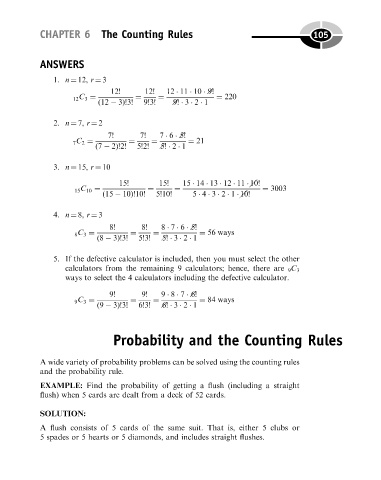
                         1. n ¼ 12, r ¼ 3
                                         12!      12!   12   11   10   9!
                                 3
                              12 C ¼            ¼     ¼               ¼ 220
                                     ð12   3Þ!3!  9!3!    9!   3   2   1
                         2. n ¼ 7, r ¼ 2
                                        7!       7!   7   6   5!
                               C ¼            ¼     ¼         ¼ 21
                              7  2
                                    ð7   2Þ!2!  5!2!  5!   2   1

                         3. n ¼ 15, r ¼ 10
                                           15!        15!    15   14   13   12   11   10!
                                C   ¼              ¼      ¼                        ¼ 3003
                               15  10
                                      ð15   10Þ!10!  5!10!     5   4   3   2   1   10!

                         4. n ¼ 8, r ¼ 3
                                        8!       8!    8   7   6   5!
                                C ¼           ¼     ¼            ¼ 56 ways
                               8  3
                                     ð8   3Þ!3!  5!3!  5!   3   2   1
                         5. If the defective calculator is included, then you must select the other

                            calculators from the remaining 9 calculators; hence, there are 9 C 3
                            ways to select the 4 calculators including the defective calculator.
                                        9!       9!    9   8   7   6!
                               9 C ¼          ¼     ¼            ¼ 84 ways
                                 3
                                     ð9   3Þ!3!  6!3!  6!   3   2   1


                                         Probability and the Counting Rules


                     A wide variety of probability problems can be solved using the counting rules
                     and the probability rule.
                     EXAMPLE: Find the probability of getting a flush (including a straight
                     flush) when 5 cards are dealt from a deck of 52 cards.

                     SOLUTION:

                     A flush consists of 5 cards of the same suit. That is, either 5 clubs or
                     5 spades or 5 hearts or 5 diamonds, and includes straight flushes.

