


Page 147 - Purchasing Power Black Kids and American Consumer Culture
P. 147
132  .  Anthropologist on Shopping Sprees


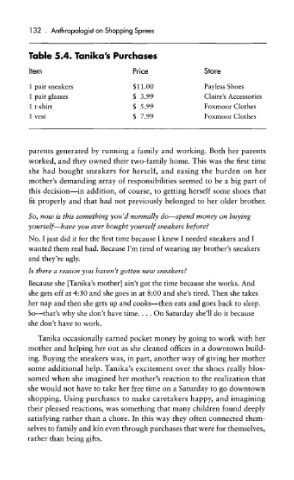
       Table  5.4.  Tanika's  Purchases

       Item                       Price              Store
       1 pair sneakers            $11.00             Payless Shoes
       1 pair glasses             $  3.99            Claire's Accessories
       1 t-shirt                  $  5.99            Foxmoor Clothes
       1 vest                     $  7.99            Foxmoor Clothes


       parents  generated  by running a family  and  working.  Both  her  parents
       worked,  and they owned  their two-family home.  This  was the first time
       she had  bought  sneakers  for  herself, and  easing  the  burden  on  her
       mother's  demanding  array  of responsibilities  seemed  to  be a big part of
       this  decision—in  addition,  of course,  to  getting herself some  shoes that
       fit properly  and that  had  not  previously belonged  to  her older  brother.
       So, now  is this something you'd  normally do—spend  money on buying
       yourself—have  you  ever bought yourself  sneakers  before?
       No.  I just did it for the first time because I knew I needed sneakers and I
       wanted them real bad. Because I'm tired of wearing my brother's sneakers
       and they're ugly.
       Is  there a reason you  haven't gotten new  sneakers*
       Because she [Tanika's mother] ain't got the time because she works. And
       she gets off at 4:30  and  she goes in at  8:00 and  she's tired. Then she takes
       her nap and then she gets up and cooks—then eats and goes back to sleep.
       So—that's why she don't have time. ... On Saturday she'll do it because
       she don't  have to work.
          Tanika  occasionally earned pocket money by going to work  with her
       mother  and  helping her out  as she cleaned  offices  in a downtown  build-
       ing. Buying the sneakers was,  in part,  another  way of giving her  mother
       some additional  help. Tanika's  excitement  over the  shoes really  blos-
       somed  when  she imagined her mother's  reaction  to the realization  that
       she would  not have to take her free  time  on a Saturday to go  downtown
       shopping.  Using purchases to make caretakers  happy,  and imagining
       their  pleased  reactions, was something that many children found deeply
       satisfying  rather  than  a chore.  In this way they often connected  them-
       selves to family and kin even through purchases that were for themselves,
       rather than being gifts.

