


Page 330 - Reservoir Formation Damage
P. 330
310    Reservoir Formation Damage

                (text  continued from  page  306)

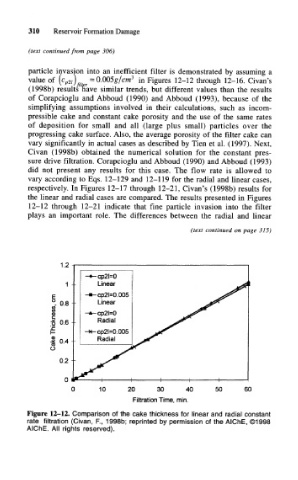
                particle  invasion  into  an  inefficient  filter  is  demonstrated  by  assuming a
                         C
                value  of  ( p2i) filer  =0.005g/cm 3  in  Figures  12-12  through  12-16.  Civan's
                (1998b)  results  have  similar  trends,  but  different  values than  the  results
                of  Corapcioglu  and  Abboud  (1990)  and  Abboud  (1993),  because  of  the
                simplifying  assumptions  involved  in  their  calculations,  such  as  incom-
                pressible  cake  and  constant  cake  porosity  and  the  use  of  the  same  rates
                of  deposition  for  small  and  all  (large  plus  small)  particles  over  the
                progressing  cake  surface. Also,  the  average porosity  of the  filter  cake  can
                vary  significantly in actual cases  as described  by Tien  et al.  (1997). Next,
                Civan  (1998b)  obtained  the  numerical  solution  for  the  constant  pres-
                sure  drive filtration. Corapcioglu  and Abboud  (1990)  and Abboud  (1993)
                did  not  present  any  results  for  this  case.  The  flow  rate  is  allowed  to
                vary  according  to Eqs.  12-129 and  12-119 for the radial  and linear  cases,
                respectively.  In Figures  12-17  through  12-21, Civan's  (1998b) results  for
                the  linear  and radial  cases  are compared.  The results presented  in  Figures
                12-12  through  12-21  indicate  that  fine  particle  invasion  into  the  filter
                plays  an  important  role.  The  differences  between  the  radial  and  linear

                                                           (text  continued  on page  315)


                                   10     20      30      40      50
                                            Filtration Time, min.
                Figure  12-12. Comparison  of the cake thickness  for  linear  and radial  constant
                rate  filtration  (Civan,  R,  1998b;  reprinted  by permission of the AlChE, ©1998
               AlChE.  All  rights  reserved).

