


Page 326 - Reservoir Formation Damage
P. 326
306   Reservoir Formation Damage


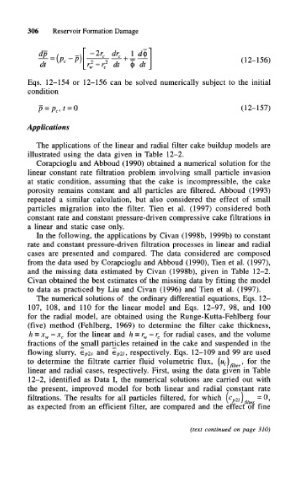
                  <£=,                                                   (12-156)
                   dt

                Eqs.  12-154  or  12-156  can  be  solved  numerically subject  to  the  initial
                condition
                                                                         (12-157)


               Applications

                  The  applications  of the  linear  and radial filter  cake buildup models  are
                illustrated  using  the  data  given  in  Table  12-2.
                  Corapcioglu  and Abboud  (1990)  obtained  a numerical  solution  for  the
                linear  constant  rate  filtration  problem  involving  small  particle  invasion
                at  static  condition,  assuming  that  the  cake  is  incompressible,  the  cake
               porosity  remains  constant  and  all  particles  are  filtered.  Abboud  (1993)
               repeated  a  similar  calculation,  but  also  considered  the  effect  of  small
               particles  migration  into  the  filter.  Tien  et  al.  (1997)  considered  both
               constant  rate  and constant  pressure-driven compressive  cake  filtrations in
                a  linear  and  static  case  only.
                  In  the following, the  applications  by  Civan  (1998b,  1999b)  to constant
               rate  and  constant  pressure-driven  filtration processes  in  linear  and  radial
               cases  are  presented  and  compared.  The  data  considered  are  composed
               from  the  data used by  Corapcioglu  and Abboud (1990),  Tien  et  al.  (1997),
                and  the  missing  data  estimated  by  Civan  (1998b),  given  in  Table  12-2.
                Civan  obtained  the best  estimates  of the missing data by fitting  the  model
               to  data  as  practiced  by  Liu  and  Civan  (1996)  and  Tien  et  al.  (1997).
                  The numerical  solutions of  the ordinary  differential  equations, Eqs. 12-
                107,  108, and  110  for  the  linear  model  and  Eqs.  12-97,  98,  and  100
                for  the  radial  model,  are  obtained  using  the  Runge-Kutta-Fehlberg  four
                (five)  method  (Fehlberg,  1969) to  determine  the  filter  cake  thickness,
                h = x w -  x c  for the linear  and  h = r w-r c  for radial  cases, and the volume
                fractions  of  the jjmall  particles  retained  in  the  cake  and  suspended  in  the
                flowing  slurry,  e p2s  and  e p 2/, respectively. Eqs. 12-109  and  99  are used
               to  determine  the  filtrate  carrier  fluid  volumetric  flux,  (M/)-.  ,  for  the
                                                                  v  * / jitter
                linear  and  radial  cases,  respectively.  First,  using the  data  given  in  Table
                12-2,  identified  as  Data  I,  the  numerical  solutions  are  carried  out  with
               the  present,  improved  model  for  both  linear  and  radial  constant  rate
               filtrations.  The  results  for  all  particles  filtered,  for  which  (c p2i)  = 0>
               as  expected  from  an  efficient  filter,  are  compared  and  the  effect  of  fine


                                                           (text  continued  on page  310)

