


Page 323 - Reservoir Formation Damage
P. 323
Cake Filtration: Mechanism, Parameters and Modeling  303

             T = 0,  and  the  second  term  on  the  right  side  of  Eq.  12-134  drops out,
             leading  to  an  expression  similar to  Corapcioglu  and Abboud  (1990)  and
             Tien  et  al.  (1997).
                    is  the  minimum  slurry  shear-stress  necessary  for  detachment  of
                i cr
             particles  from  the progressing  cake  surface. Following  Ravi et  al.  (1992),
             the  critical  shear  stress necessary  for detachment of the  deposited  particles
             from  the progressing  cake  surface can  be  estimated according  to  Potanin
             and  Uriev  (1991)  by  Eq.  12-6.  However,  the  actual critical  stress  can be
             substantially  different  than predicted  by  Eq.  12-6, because the ideal theory
             neglects  the  effects  of  the  other  factors,  including  aging  (Ravi  et  al.,
             1992),  surface  roughness,  and  particle  stickiness  (Civan,  1996) on  the
             particle  detachment.  Therefore,  Ravi  et  al.  (1992)  recommend  that  the
             critical  shear  stress  be  determined  experimentally.  U(i s-i cr)  is  the
             Heaviside  unit  step  function.  It  is  equal  to  zero  when  i s < i cr  and one
             for  T^t cr .  kj  and  k°  are  the  rate  coefficients for  the  total  (fine  plus
             large) particles deposition  and detachment at the progressing  cake surface.
                 and    are  the  rate coefficients for  the  fine_ particles  deposition  and
             k° 2    k° 2
             detachment  at  the  progressing  cake  surface.  k d  and  k e  are  the  cake-
             thickness-average  rate  coefficients  for  the  deposition  and mobilization of
             the  fine  particles  within the  filter  cake  matrix.


             Porosity  and  Permeability   Relationships

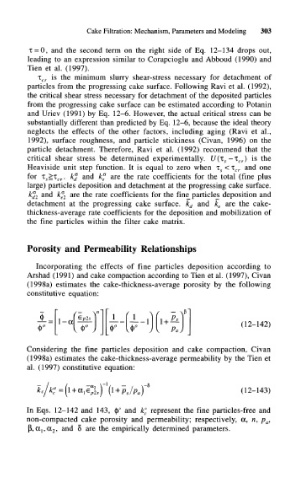
               Incorporating  the  effects  of  fine  particles  deposition  according  to
             Arshad  (1991)  and  cake compaction according to Tien  et al.  (1997), Civan
             (1998a)  estimates  the  cake-thickness-average  porosity  by  the  following
             constitutive  equation:


                                          °                           (12-142)


             Considering  the  fine  particles  deposition  and  cake  compaction,  Civan
             (1998a)  estimates  the cake-thickness-average  permeability by  the Tien  et
             al.  (1997)  constitutive equation:


                                                                      (12-143)

             In  Eqs. 12-142  and  143,  <j)°  and  k° c  represent  the  fine  particles-free  and
             non-compacted  cake  porosity  and  permeability;  respectively,  a,  n,  p a,
             P, a^a 2,  and  8  are the empirically  determined  parameters.

