


Page 321 - Reservoir Formation Damage
P. 321
Cake Filtration: Mechanism, Parameters and Modeling  301


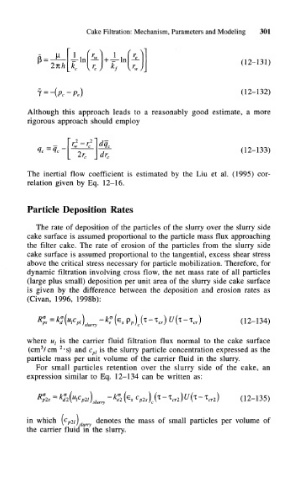
                                                                      (12-131)
                    271 h           V   \'w


                Y = -(p c -p e )                                      (12-132)

             Although  this  approach  leads  to  a  reasonably  good  estimate,  a  more
             rigorous  approach  should  employ

                          2
                         r -r 'c 2
                         'w
                                                                      (12-133)
                           2r,
             The  inertial  flow  coefficient  is  estimated  by  the  Liu  et  al.  (1995) cor-
             relation  given  by  Eq.  12-16.


             Particle  Deposition  Rates
                The rate of  deposition  of the particles  of the  slurry  over  the  slurry  side
             cake  surface is assumed proportional  to  the particle  mass flux approaching
             the  filter  cake.  The  rate  of  erosion  of  the  particles  from  the  slurry  side
             cake  surface is  assumed proportional  to the tangential, excess  shear  stress
             above the  critical  stress  necessary  for particle mobilization. Therefore,  for
             dynamic  filtration  involving cross  flow,  the  net  mass  rate  of  all  particles
             (large plus  small) deposition  per unit area  of the  slurry side  cake  surface
             is  given  by  the  difference  between  the  deposition  and  erosion  rates  as
             (Civan,  1996, 1998b):


                                                                      (12-134)

             where  u t  is  the  carrier  fluid  filtration  flux  normal  to  the  cake  surface
                 3
                      2
              (cm / cm  • s)  and  c pl  is  the  slurry particle  concentration expressed  as  the
             particle  mass  per  unit volume  of  the  carrier  fluid  in  the slurry.
                For  small  particles  retention  over  the  slurry  side  of  the  cake,  an
             expression  similar  to  Eq.  12-134  can  be  written  as:

                                                                      (12-135)

                       c
             in  which  \ pii) slur  denotes  the  mass  of  small  particles  per  volume  of
             the  carrier  fluid  in  the  slurry.

