


Page 318 - Reservoir Formation Damage
P. 318
298   Reservoir Formation Damage

                assuming  p p  is  constant  and  substituting  Eq.  12-112.  The  present
                Eqs.  12-106  and  12-109  simplify  to  their  Eqs. 24  and  28, substituting
                Eq.  12-113  for e p2l«e l. Also,  Corapcioglu  and Abboud (1990)  did not
                distinguish  between  the  rates  of  deposition  of  small  and  all  (large  plus
                small)  particles  over the progressing cake  surface (i.e.,  R p2s  and  R° s)  and
                used  Rp 2s  = Rp S  in their  Eq.  24. This  assumption  is not valid  because  most
                small  particles  migrate into the cake  and only a little  fraction  of  the  small
                particles  can  deposit  by  the jamming  process  over  the  slurry  side  of  the
                filter  cake,  such  as  described  by  Civan  (1996).  The  filter  cake  is  essen-
                tially  formed  by  the  deposition  of  the  large  particles  and  the  deposition
                of  the  small particles  over  the progressing  cake  surface is negligible. The
                deposition  of  the  small  particles  more  dominantly occurs  within  the
                cake  matrix  as  the  suspension  of  small  particles  flows  through  the
                cake.  Therefore,  there  is  a  large  order  of  magnitude difference  between
                the  rates  of  the  small  and  large  particles  deposition  over  the  filter  cake
                (i.e.,  Rp ls »  Rp 2s  and, thus,  R° s  = Rp ls).  However, it  is more  accurate to
                use  Eq.  12-91.

                Pressure-Flow    Relationships

                                                        3
                                                             2-
                  The  slurry  carrier  fluid  flow  rate  «, (cm /cm s)  can  be  expressed
                using  the  effluent  fluid  pressure  p e(atm)  at  the  outlet  side  of  the  filter,
                the  pressure  p c(atm)  at  the  slurry  side  cake  surface,  and  the  harmonic
                average  permeability  of  the  cake  and  filter  system.
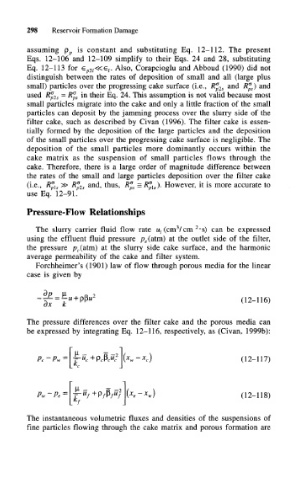
                  Forchheimer's  (1901) law  of  flow through porous media for the linear
                case  is  given  by


                                                                         (12-116)
                    dx   k
                The  pressure  differences  over  the  filter  cake  and  the  porous  media  can
                be  expressed  by integrating Eq.  12-116, respectively,  as (Civan,  1999b):


                              -
                   Pc-P»=\T-Uc+f>£c"?\(Xw-Xc)                            (12-117)


                   P W~Pe =                                              (12-118)


                The  instantaneous volumetric  fluxes  and  densities  of  the  suspensions of
                fine  particles  flowing  through the  cake  matrix  and  porous formation are

